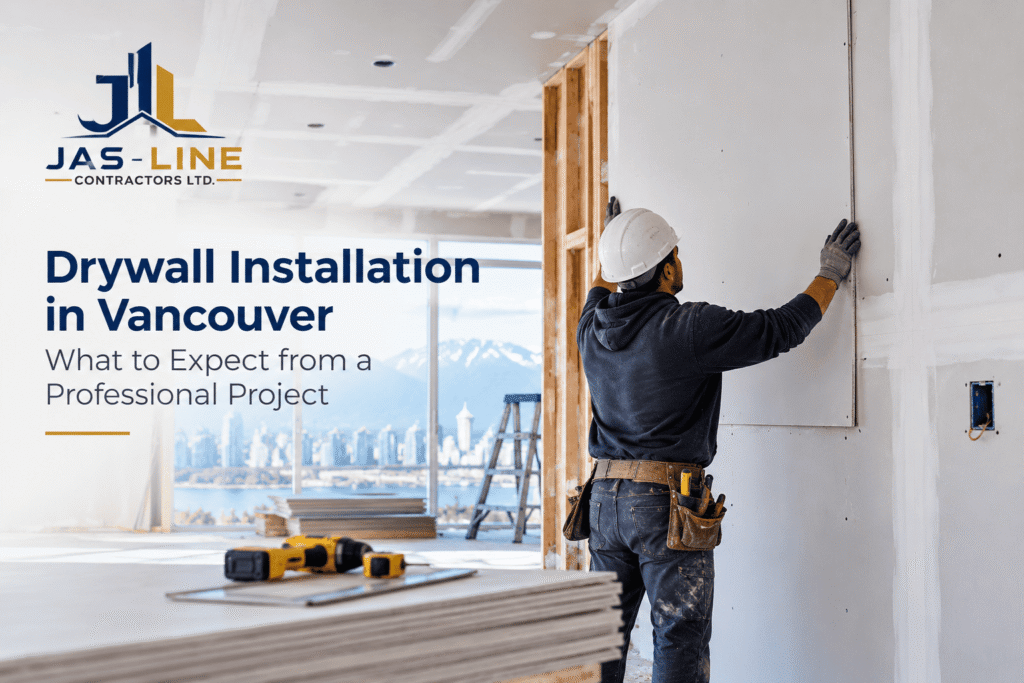
Drywall is one of the last major steps between an open interior and a finished room. Once framing and the work behind the walls are ready, drywall creates the surfaces that will eventually be painted, decorated or otherwise finished.
But installing drywall is not simply a matter of attaching sheets to studs. The result depends on how the project is prepared, how the boards are laid out and fastened, and how carefully the joints, corners and openings are finished.
For homeowners, property managers and builders planning a renovation or new construction project, understanding what is involved in drywall installation in Vancouver makes it easier to plan the work, compare scopes and know what to expect from a contractor.
What does Drywall Installation involve?
A typical drywall project can include several stages, although the exact scope depends on the building and the work being carried out.
A project may involve:
- Reviewing the framing and existing conditions
- Preparing the work area
- Measuring and cutting drywall sheets
- Installing drywall on walls and ceilings
- Fastening the boards to the framing
- Treating joints, corners and fastener locations
- Applying joint compound
- Sanding and checking the finished surface
- Preparing the walls and ceilings for the next finish
The scope can be quite different for a new home, a commercial interior, a basement renovation or a small drywall repair.
Before work starts, the contractor should be clear about what is included. Drywall installation services, taping, mudding, sanding, repairs and final cleanup are not necessarily separate or automatic parts of every quote.
📞 Contact Us today to discuss your drywall project.
Why Does Drywall Installation Matter in Vancouver and BC?
There is nothing unique about the basic process of installing drywall simply because a project is in Vancouver. However, projects in British Columbia still need to be approached according to the building design, project specifications and applicable requirements.
For example, some wall and ceiling assemblies have specific fire-resistance or sound-transmission requirements. The BC Building Code contains tested or specified assemblies using gypsum board, framing and other components, which means the performance of an assembly depends on how all of those components are put together.
That is why choosing drywall based only on appearance is not enough for every project.
The appropriate board, thickness, number of layers, framing arrangement, fasteners and other components should be determined from the project requirements. Where a fire-rated or sound-rated assembly is specified, the installation needs to follow the applicable design or listed assembly rather than being improvised on site.
For a Vancouver renovation or construction project, this coordination should happen before the drywall is installed.
What to Expect Before the Drywall Goes Up
Good drywall work starts before the first sheet is lifted into place.
The framing should be ready, and work that needs to be completed inside the wall or ceiling cavity should be addressed first. Depending on the project, this can include electrical, plumbing, insulation and other concealed services.
If the project also requires insulation and vapour barrier services, these should be coordinated before the drywall closes the wall or ceiling cavity.
The installer also needs to know where doors, windows, electrical boxes, vents, access panels and other openings will be located.
This preparation is particularly useful during renovations. Existing construction may not be perfectly straight or may contain conditions that are not obvious until the wall is opened. Taking the time to inspect those conditions can reduce unnecessary cutting and patching later.
A drywall installation contractor in Vancouver should also understand how the drywall work fits into the wider construction schedule. There is little value in finishing a wall only to have another trade reopen it because something behind the drywall was missed.
Choosing the Right Drywall for the Project
Different spaces can have different drywall requirements.
Standard gypsum board is suitable for many interior applications, but other products or assemblies may be specified where the project calls for particular performance characteristics.
Depending on the design, considerations may include:
- Fire resistance
- Moisture exposure
- Impact resistance
- Acoustic performance
- Thickness and board configuration
- Ceiling or wall application
- Required finish
Fire and sound performance deserve particular care. The BC Building Code provides examples of complete wall and floor/ceiling assemblies with specific fire-resistance and sound-transmission characteristics. Those ratings are tied to the construction details of the assembly, not simply to the presence of a particular drywall product.
For that reason, a drywall contractor in Vancouver should work from the drawings, specifications and applicable requirements when determining what materials and assembly details are needed.
The Drywall Installation Process
Once the area is ready and the materials have been selected, installation can begin.
Measuring and Cutting
Each sheet needs to be measured and cut for its intended location.
Openings for electrical boxes, doors, windows, vents and other fixtures need to be positioned accurately. Good layout reduces unnecessary joints and makes the finishing stage easier.
On larger projects, sheet layout also needs to be coordinated with the framing and the overall wall and ceiling design.
Installing the Boards
The drywall sheets are then positioned and secured to the framing using the appropriate fastening method for the project.
Fasteners need to be properly placed and driven without unnecessarily damaging the board. A fastener that is driven too deeply can break the paper facing and create a weak point that is harder to finish.
Joints, corners and transitions also need to be considered as the boards are installed.
Ceilings require particular care because the boards must be adequately supported and handled safely during installation.
Working Around Openings
Windows, doors, electrical boxes and mechanical openings all require accurate cuts.
An opening that is cut too large may need additional patching, while a poorly positioned opening can create problems for the finishing stage.
These details are easy to overlook when looking only at the larger wall surface, but they become noticeable once the room is painted.
Drywall Taping and Finishing
Installing the boards is only part of the job. The joints between sheets still need to be finished.
Drywall Taping
Drywall taping involves placing joint tape over the seams between boards and applying joint compound over the joint.
The purpose is to create a continuous surface rather than leaving the individual drywall sheets visually separated.
Joint compound is normally applied in stages. Each coat needs suitable drying time before the next stage of finishing can continue.
For projects requiring drywall taping and finishing services, the final appearance depends heavily on how carefully the joints and fastener locations are treated.
Drywall Mudding
The joint compound, often referred to as mud, is built up over the joint and feathered outward.
The objective is to make the transition from the joint to the surrounding drywall gradual enough that it does not stand out once the wall has been finished.
This is where rushed work can become obvious. Uneven compound, poorly feathered joints or insufficient attention to fastener locations can remain visible after painting.
Drywall Sanding
Once the compound has dried, the surface is sanded to remove ridges and smooth the transition.
Sanding needs to be controlled. Too little can leave visible imperfections, while excessive sanding can damage the drywall facing or create low areas in the finished joint.
The amount of finishing required depends on the specified surface finish and how the room will ultimately be lit and used.
Strong natural or artificial lighting can make surface imperfections more noticeable, so finish expectations should be discussed before work begins.
📞 Contact Us today for your drywall installation needs.
Corners, Edges and Other Details
Flat drywall joints are only one part of the finishing process.
Outside corners commonly use corner bead or another suitable reinforcing method to create a straight, durable edge. Inside corners also require careful taping and finishing.
The areas around windows, doors, electrical boxes and other openings need to be finished properly as well.
A room can have well-installed drywall sheets but still look unfinished if these smaller details are neglected.
This is one reason drywall finishing services should be considered part of the overall quality of the project rather than an afterthought.
Fire, Moisture and Sound Considerations
Some drywall projects have requirements that go beyond creating a smooth surface.
Fire Resistance
Where a wall or ceiling forms part of a required fire-resistance-rated assembly, the complete assembly needs to be built according to the applicable design or code requirements.
The BC Building Code provides specific assembly information for gypsum-board construction, including fire-resistance ratings for certain wall and floor/ceiling assemblies.
A contractor should therefore avoid treating “fire-rated drywall” as a standalone solution. The framing, board type and thickness, number of layers, fasteners and other construction details can all form part of the required assembly.
Sound Control
Sound performance also depends on the complete wall or ceiling assembly.
The BC Building Code lists sound-transmission characteristics for specific assemblies, showing that framing, cavity materials, gypsum board and other construction details work together to affect performance.
If acoustic performance is a project requirement, the intended assembly should be established before installation rather than trying to improve sound control after the wall is already finished.
Moisture Exposure
Some areas require materials and construction methods suited to the conditions of the space.
Bathrooms, utility areas and other locations with moisture exposure should be considered according to the project’s design and specifications. The correct approach is not necessarily the same for every room.
Residential vs. Commercial Drywall Installation
The basic drywall process is similar across many projects, but the practical requirements can be very different.
Residential Drywall Installation
Residential work may include:
- New interior walls
- Basement developments
- Ceiling installation or replacement
- Room renovations
- Interior partitions
- Drywall repair and patching
- Preparation for painting
Homeowners will usually pay close attention to the appearance of the finished surface. Access, protection of existing areas, dust control and coordination with other renovation work can also affect the project.
For residential drywall installation in Vancouver, it is useful to confirm exactly what the contractor is including in the scope, particularly if the drywall is part of a larger renovation.
Where repairs are required, drywall repair services can address damaged or removed sections before the final finishing stage.
Commercial Drywall Installation
Commercial work can include offices, retail spaces, tenant improvements, multi-unit residential buildings and new construction.
Larger projects generally involve more coordination between trades. Wall layouts, mechanical and electrical services, access, scheduling and site logistics can all affect the drywall sequence.
Commercial drywall installation in Vancouver should therefore be planned around the project’s drawings, specifications and construction schedule.
The same approach applies to new construction drywall in Vancouver: the drywall contractor needs to work within the sequence established by the wider project team.
For larger projects, commercial drywall services can be coordinated with the broader construction schedule and other trades working on site.
Common Drywall Problems to Watch For
Good finishing depends on both installation and preparation. Some common problems include:
Visible Seams
Poor taping or insufficient feathering can leave joints visible after painting.
Fastener Pops
Improperly installed fasteners or movement in the assembly can result in fastener heads becoming visible through the finished surface.
Uneven Corners
Poorly installed or finished corner bead can result in crooked or inconsistent outside corners.
Over-Sanding
Aggressive sanding can damage the drywall paper or create depressions in the finished joint.
Poorly Cut Openings
Oversized or inaccurate cuts around electrical boxes, doors, windows and other openings can lead to unnecessary patching.
Incomplete Surface Preparation
Dust, ridges, unfinished compound or other surface defects can affect the final paint or coating.
A good drywall installer in Vancouver should inspect the finished surface before considering the drywall work complete.
How long does Drywall Installation Take?
There is no reliable single timeline for every drywall project.
The schedule can depend on:
- The amount of wall and ceiling area
- Number of rooms
- Ceiling height
- Number of openings and details
- Type of drywall
- Required finish
- Site access
- Number of workers
- Coordination with other trades
- Drying time between coats of joint compound
A small room may progress relatively quickly, while a larger renovation or commercial project can take considerably longer.
The finishing stage is also not simply a matter of applying compound once and moving on. Multiple applications, drying and sanding may be required to achieve the specified result.
For that reason, a contractor should provide a project-specific schedule rather than promising a fixed timeline without seeing the work.
How to Choose a Drywall Contractor in Vancouver
When comparing drywall contractors in Vancouver, price is only one part of the decision.
Start by making sure the scope is clear.
Ask:
- What areas are included?
- Are walls and ceilings both included?
- What type of drywall is being proposed?
- Is taping included?
- Is mudding and sanding included?
- What finish is expected?
- Are corners and openings included?
- Is drywall repair included where needed?
- How will the work be coordinated with other trades?
- Is cleanup included?
It is also worth asking whether the contractor has experience with the type of project you are planning. A small residential repair, a complete renovation and a commercial tenant improvement can have very different requirements.
A good drywall company in Vancouver should be able to explain the proposed scope in straightforward terms rather than leaving the client to guess what is included.
📞 Contact Us today to discuss your project with Jas-Line Contractors Ltd.
Drywall Installation for Renovations: What Homeowners Should Know
Renovation projects can be less predictable than new construction.
Existing walls may contain old materials, uneven framing, previous repairs or concealed services that were not part of the original plan. Once the wall is opened, the actual condition may be different from what was visible beforehand.
This does not necessarily mean the project will become complicated, but it is one reason renovation drywall work should allow for proper inspection and coordination.
For drywall installation for renovations, the contractor should identify existing conditions, confirm what needs to be removed or repaired and establish how the new drywall will connect with the surrounding surfaces.
That preparation can make the finishing stage much cleaner.
Why the Finishing Stage Deserves Attention
Drywall covers a large percentage of an interior space, so small defects can become noticeable once the room is painted.
The quality of the final surface is influenced by the entire sequence:
Preparation → Layout → Installation → Taping → Mudding → Sanding → Inspection → Final finish
Skipping or rushing one stage can affect the stages that follow.
This is particularly true for drywall finishing services, where the finished walls may be viewed under different types of natural and artificial lighting.
The goal should be a surface that matches the agreed finish and is properly prepared for the next stage of the project.
Frequently Asked Questions
1. What does drywall installation include?
Depending on the project scope, drywall installation can include measuring, cutting and fastening drywall sheets, followed by taping, joint-compound application, sanding and surface preparation.
2. How much does drywall installation cost in Vancouver?
There is no single price that applies to every project. Cost can vary according to the size and condition of the space, materials, ceiling height, number of openings, required finish, access and labour. A project-specific assessment is more useful than relying on a general price.
3. How long does drywall installation take?
The schedule depends on the size and complexity of the project, the number of rooms, site access, drywall type, finishing requirements and drying time between coats of joint compound.
4. What is the difference between drywall installation and drywall finishing?
Drywall installation generally refers to measuring, cutting and securing the boards to the framing. Drywall finishing includes treating joints, corners and fasteners with tape and joint compound, followed by sanding and preparation for the final surface finish.
5. Should I hire a drywall contractor for a renovation?
For larger renovations, ceilings, complex layouts or projects with specific assembly requirements, working with an experienced drywall contractor can help with installation, finishing and coordination with the rest of the construction work.
6. What should I ask a drywall contractor before starting?
Ask what areas and stages are included, which materials are proposed, what level of finish is expected, whether taping and sanding are included, how openings and corners will be handled, and how the drywall work will fit into the overall project schedule.
Final Thoughts
A good drywall project is built around more than putting gypsum board on a wall.
From checking the framing and coordinating work behind the walls to selecting the appropriate materials, installing the boards, taping the joints and preparing the surface for its final finish, each stage has a role.
Whether you are planning a home renovation, commercial improvement or new construction project, understanding the drywall installation process in Vancouver can help you ask better questions and establish a clearer project scope.
For Jas-Line Contractors Ltd., the practical approach is to treat drywall as part of the overall construction sequence, not as an isolated task. Clear planning, suitable materials and careful finishing help create walls and ceilings that are ready for the next stage of the project.