When planning a construction project, choosing the right framing system is an important decision. Metal stud framing has become a popular option for both residential and commercial construction because of its strength, durability, dimensional stability, and design flexibility.
Although residential and commercial projects can both use steel stud framing, the framing requirements can vary significantly depending on the building type, size, structural needs, fire-resistance requirements, and overall project complexity.
In this guide, we explain the key differences between residential steel framing and commercial steel stud framing so you can better understand which framing solution may be suitable for your project.
What Is Metal Stud Framing?
Metal stud framing is a construction method that uses cold-formed steel members, including vertical studs and horizontal tracks, to create walls, partitions, and framing systems.
Compared with traditional wood framing, steel framing offers consistent dimensions and is resistant to issues such as rot, termites, and warping.
Light gauge steel framing is commonly used for interior walls and partitions, while heavier-gauge steel members can be used for applications that require additional structural capacity.
The right steel gauge and framing system should always be selected according to the project’s design, engineering requirements, and applicable building codes.
What Is Residential Steel Framing?
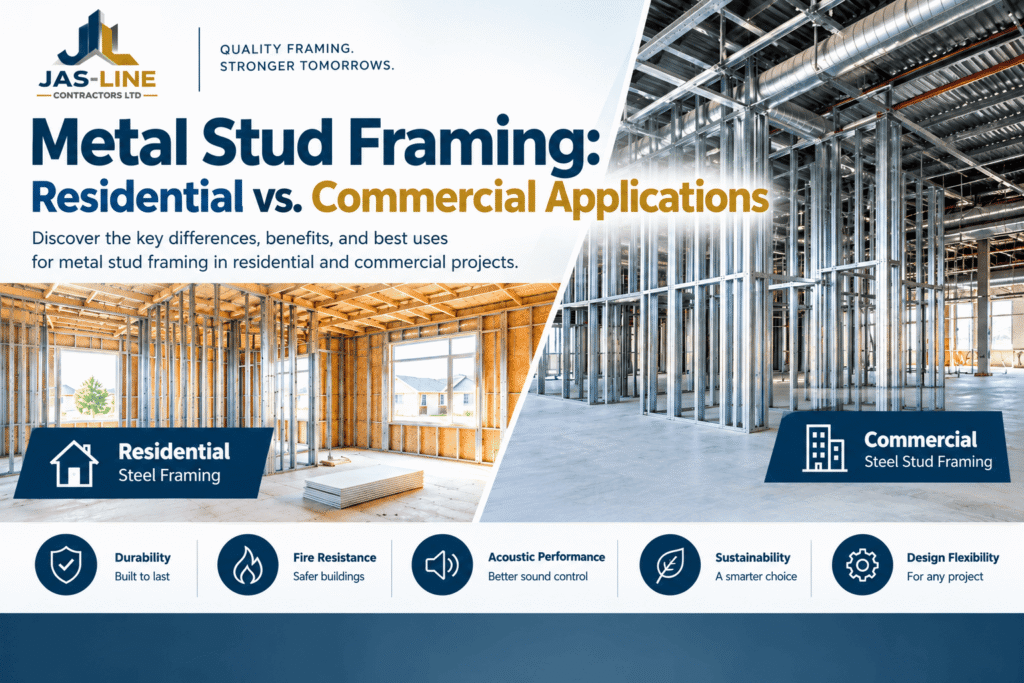
Residential steel framing is used in houses, townhomes, apartments, renovations, and other residential construction projects.
It can be used for interior partitions, exterior wall systems, ceilings, and other framing applications depending on the project’s structural design.
Common Residential Applications
Steel stud framing can be used for:
- Single-family homes
- Townhomes
- Multi-family residential buildings
- Basement renovations
- Interior partition walls
- Home additions
- Garage conversions
- Renovation and remodeling projects
One of the major advantages of residential metal stud framing is its dimensional stability. Steel members are not affected by moisture in the same way as wood and do not provide a food source for termites. CONTACT US
What Is Commercial Steel Stud Framing?
Commercial steel stud framing is commonly used in larger and more complex construction projects where wall systems may need to meet specific structural, fire-rating, acoustic, and code requirements.
Commercial projects often involve multiple trades working together, so accurate installation and coordination are particularly important.
Common Commercial Applications
Commercial metal framing is frequently used for:
- Office buildings
- Retail stores
- Restaurants
- Healthcare facilities
- Educational buildings
- Multi-unit residential buildings
- Warehouses and industrial spaces
- Commercial renovations
- Interior partitions
- Exterior wall systems
Depending on the project, light gauge steel framing or heavier structural steel framing systems may be specified.
Residential vs. Commercial Metal Stud Framing
While both applications use steel framing, the main difference is usually the project’s size, complexity, structural requirements, and code requirements.
1. Project Size and Complexity
Residential projects are often smaller and may have fewer structural and coordination requirements.
Commercial projects can be significantly larger and may involve multiple floors, larger wall systems, complex layouts, and coordination between architects, engineers, contractors, and other trades.
Because of this, commercial steel stud framing generally requires more detailed planning and coordination.
2. Structural Requirements
The required steel gauge, stud size, spacing, and connection methods depend on the design of the building.
For residential projects, framing requirements may be relatively straightforward depending on the application.
Commercial buildings may require more detailed engineering because walls can be subject to higher loads, larger spans, wind loads, or other structural requirements.
This is why professional assessment is important when selecting a steel framing system.
3. Fire Resistance
Fire performance is an important consideration in many construction projects.
Steel is non-combustible, and properly designed metal stud framing systems can be incorporated into wall assemblies designed to achieve specific fire-resistance ratings.
Commercial buildings often have more demanding fire-separation requirements because of occupancy, building size, and local building codes.
4. Acoustic Performance
Sound control can also influence the design of a framing system.
In apartments, offices, hotels, healthcare facilities, and other buildings where privacy is important, steel wall framing can be combined with insulation, gypsum board, and other materials to create wall assemblies designed for improved acoustic performance.
The final performance depends on the complete wall assembly rather than the steel studs alone.
5. Installation and Trade Coordination
Residential framing projects may involve fewer trades and simpler layouts.
Commercial construction typically requires greater coordination between framing contractors, electricians, plumbers, HVAC contractors, drywall installers, and other trades.
A professional steel stud framing contractor can help ensure that framing layouts are installed accurately and coordinated with the overall construction plan.
6. Building Codes and Engineering
Both residential and commercial projects must comply with applicable building codes and project requirements.
However, commercial projects can involve more complex requirements related to structural design, fire separation, occupancy, accessibility, and building performance.
For this reason, commercial metal framing contractor services often involve detailed drawings, engineering coordination, material specifications, and inspections. CONTACT US
Key Benefits of Metal Stud Framing
Whether used in residential or commercial construction, metal stud framing offers several important advantages.
Durability
Steel framing provides a strong and durable framing solution when properly designed and installed.
Dimensional Stability
Unlike wood, steel studs do not naturally shrink, twist, or warp due to changes in moisture content.
Resistance to Rot and Termites
Steel does not rot and does not provide a food source for termites, making it a practical option for many building applications.
Non-Combustible Material
Steel is non-combustible, which can be an important consideration when designing building assemblies for fire performance.
Design Flexibility
Light gauge steel framing can be manufactured in different sizes and gauges to meet various project requirements.
Consistent Installation
Factory-produced steel members provide consistent dimensions, which can help contractors achieve accurate framing layouts.
Steel Framing vs. Wood Framing
When comparing steel framing with wood framing, the right choice depends on the project’s design, budget, location, structural requirements, and building-code requirements.
Wood remains widely used in residential construction, while metal stud framing is commonly selected for commercial interiors and other applications where durability, dimensional stability, and non-combustibility are important.
For some projects, steel and wood may even be used together as part of an overall building system.
Which Metal Stud Framing System Is Right for Your Project?
The best framing solution depends on several factors, including:
- Building type
- Project size
- Wall height
- Structural requirements
- Fire-rating requirements
- Acoustic requirements
- Local building codes
- Interior or exterior application
- Engineering specifications
- Overall project budget
A professional assessment can help determine whether residential steel framing, commercial steel stud framing, or another framing system is appropriate for the project.
Why Choose a Professional Steel Stud Framing Contractor?
Proper installation is just as important as selecting the right framing material.
An experienced steel stud framing contractor can help with:
- Framing layout and planning
- Material selection
- Stud and track installation
- Wall alignment
- Structural coordination
- Fire-rated wall assemblies
- Acoustic wall assemblies
- Coordination with other trades
- Project-specific installation requirements
Professional installation can help improve accuracy, efficiency, and the overall quality of the finished framing system.
Final Thoughts
Both residential and commercial projects can benefit from metal stud framing, but the requirements are not always the same.
Residential steel framing may be suitable for homes, renovations, townhomes, and multi-family projects, while commercial steel stud framing is often used in offices, retail spaces, healthcare facilities, educational buildings, and other larger or more complex projects.
The right solution depends on the project’s structural requirements, building codes, design, fire and acoustic requirements, and installation conditions.
If you’re planning a residential or commercial construction project, choosing the right steel framing system and working with an experienced steel stud framing contractor can make an important difference in the quality and performance of your building. CONTACT US
Frequently Asked Questions
1. What is metal stud framing?
Metal stud framing is a construction system that uses cold-formed steel studs and tracks to create walls, partitions, and other framing assemblies.
2. Is steel stud framing suitable for residential construction?
Yes. Steel stud framing can be used in homes, townhomes, multi-family buildings, renovations, and other residential applications, depending on the project’s design and engineering requirements.
3. Is metal stud framing good for commercial buildings?
Yes. Commercial steel stud framing is widely used for interior partitions and other commercial construction applications because of its durability, consistency, and flexibility.
4. What is the difference between residential and commercial steel framing?
The primary differences are usually project size, structural requirements, fire and acoustic requirements, building codes, engineering needs, and coordination with other construction trades.
5. What is light gauge steel framing?
Light gauge steel framing uses relatively thin, cold-formed steel members to create framing systems for walls, partitions, ceilings, and certain structural applications.
6. Is steel framing better than wood framing?
Neither material is automatically better for every project. The appropriate choice depends on factors such as building design, structural requirements, budget, building codes, durability requirements, and project conditions.
7. Why use steel wall framing?
Steel wall framing can provide dimensional stability, durability, resistance to rot and termites, and a non-combustible framing material for suitable wall assemblies. CONTACT US