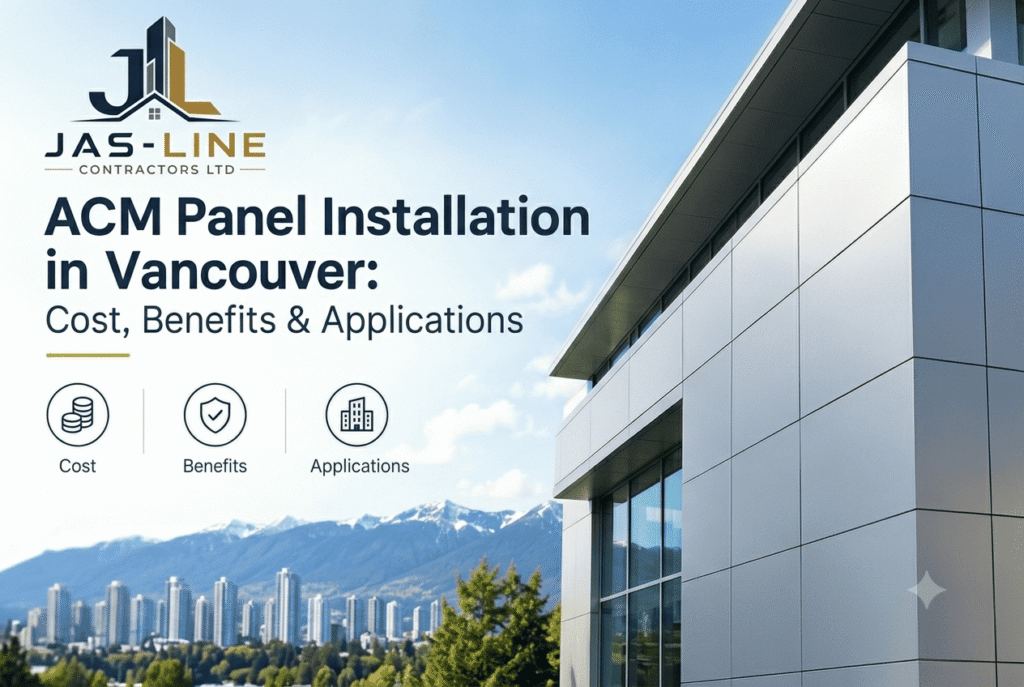
Aluminium composite material (ACM) panels are a common choice for modern exterior façades, particularly on commercial and architectural projects. They offer a clean appearance, relatively low weight, and flexibility in panel layouts and finishes.
For property owners and contractors considering ACM panel installation Vancouver, there is more to the project than selecting a colour and fastening panels to a wall. The existing substrate, support system, panel specification, joints, openings, moisture management, fire performance, and applicable building requirements all need to be considered as part of the overall wall assembly.
Cost is another major consideration. ACM panel cost Vancouver projects can vary considerably depending on the size and complexity of the building, panel specification, access, substrate condition, detailing, labour, and the scope of work. A site-specific assessment is therefore much more useful than relying on a generic square-foot price.
What are ACM Panels?
ACM stands for Aluminium Composite Material. An ACM panel generally consists of aluminium skins bonded to a core. Products are available in different thicknesses, finishes, colours, and configurations for architectural applications.
ACM panels Vancouver projects may use can provide a consistent exterior finish while allowing designers to create different panel layouts, lines, colours, and façade details.
However, ACM is not one standard product. Different panels can have different core compositions, fire-performance characteristics, finishes, and installation requirements. The appropriate product needs to be selected according to the project’s design, specifications, and applicable requirements.
📞 Call us or Contact Us today.
Why Consider ACM Cladding in Vancouver?
There are several reasons property owners and designers consider ACM for exterior applications.
Clean, Modern Appearance
One of the main advantages of ACM cladding Vancouver projects is the clean appearance it can provide. Panels can be arranged vertically, horizontally, or in other layouts depending on the design.
For a building renovation, ACM can also be used to update selected exterior areas without necessarily replacing every component of the building envelope.
Lightweight Material
ACM panels are relatively lightweight compared with some other façade materials. This can make handling and installation practical, although the complete cladding assembly still needs suitable support and attachment.
The weight of the panel alone should not be used to determine whether a particular system is appropriate for a building.
Flexible Design Options
Aluminum composite cladding is available in various colours and finishes. Panels can also be fabricated into different shapes and configurations.
This flexibility can be useful for:
- Building entrances
- Feature areas
- Exterior columns
- Retail façades
- Signage backgrounds
- Architectural accents
- Commercial building exteriors
Applications Across Different Building Types
Depending on the design and applicable requirements, ACM systems may be considered for:
- Commercial buildings
- Retail properties
- Office buildings
- Institutional buildings
- Industrial buildings
- Tenant improvement projects
- Building renovations
- Selected residential applications
The suitability of an ACM system should always be evaluated based on the specific building and wall assembly.
ACM Panel Installation in Vancouver: What does the Process involve?
A proper ACM panel installation involves more than attaching finished panels to an existing wall. The installer needs to understand how the panels interact with the substrate and the rest of the exterior wall system.
1. Assess the Existing Wall
Before work begins, the existing wall or substrate should be reviewed.
Depending on the project, this may involve considering:
- Existing cladding
- Substrate condition
- Structural support
- Attachment points
- Wall openings
- Windows and doors
- Existing moisture-management details
- Project drawings and specifications
This step is particularly relevant for renovation projects, where the existing construction may differ from what is shown in older drawings.
2. Plan the Panel Layout
Accurate measurements and layout planning help establish where panel joints, corners, openings, and transitions will occur.
Windows, doors, penetrations, signage, and other façade features should be considered before fabrication. A well-planned layout can also help keep panel lines consistent across the façade.
3. Prepare the Support System
The ACM panels need an appropriate method of attachment and support.
Depending on the specified system, installation may involve framing, rails, clips, fasteners, or other components. The exact arrangement should follow the project design and the manufacturer’s requirements.
4. Fabricate the Panels
Panels may need to be cut, routed, folded, or otherwise fabricated to suit the building.
Accuracy matters particularly around:
- Windows
- Doors
- Corners
- Signage
- Mechanical penetrations
- Architectural features
Poor measurements at this stage can create alignment problems during installation.
5. Install the Panels
Once the substrate and support system are ready, the panels are installed according to the selected system.
Joints, fasteners, trims, flashings, corners, and transitions all need to be coordinated. The manufacturer’s installation instructions should be followed rather than applying a generic method to every project.
6. Review the Completed Work
The finished façade should be checked for panel alignment, joint consistency, visible fasteners where applicable, transitions, trims, and other installation details.
A final review can also identify areas that require adjustment before the project is considered complete.
How much does ACM Panel Installation Cost in Vancouver?
There is no single price that applies to every ACM panel installation Vancouver project.
The ACM cladding cost Vancouver property owners encounter can depend on several factors, including:
- Total area of the façade
- Panel specification
- Panel thickness and finish
- Core type
- Building height
- Site accessibility
- Existing wall condition
- Substrate preparation
- Support and framing requirements
- Number of corners and openings
- Window and door detailing
- Flashings and trims
- Labour
- Removal of existing cladding
- Engineering or design requirements
- Project scheduling
For example, a straightforward façade with easy access can have a very different scope from a multi-storey building with numerous windows, corners, penetrations, and difficult access.
What Should an ACM Installation Quote Include?
When comparing quotations, look beyond the panel price.
A complete project may involve:
- ACM panels
- Support components
- Fasteners
- Trims
- Flashings
- Substrate preparation
- Removal of existing materials
- Labour
- Access equipment
- Other related wall-system components
A lower panel price does not necessarily mean a lower overall project cost if significant preparation or additional work is excluded.
For an accurate ACM panel cost Vancouver estimate, the contractor should understand the actual building, existing conditions, proposed system, and scope of work.
Fire Performance and Building Code Considerations
Fire performance needs to be considered when selecting exterior cladding.
Not all composite panels have the same core or fire characteristics. More importantly, the performance of an exterior wall depends on the complete wall assembly, which can include the cladding, insulation, membranes, sheathing, framing, and other components.
The BC Building Code 2024 includes provisions dealing with combustible cladding and exterior wall assemblies, with requirements that vary depending on the building and specific circumstances.
For Vancouver projects, it is also important to recognise that the City of Vancouver adopted the 2024 BC Building Code with Vancouver-specific provisions through its 2025 Vancouver Building By-law.
This is why a particular ACM panel should not be assumed to be suitable for every building simply because it has been used successfully on another project.
Where a project has specific fire-performance requirements, the proposed panel and complete wall assembly should be reviewed against the applicable code provisions, project specifications, and required testing or approvals.
The National Research Council of Canada publishes national model codes, but the applicable code for a project is determined by the relevant provincial or territorial jurisdiction.
📞 Call us or Contact Us today.
Where Are ACM Panels Commonly Used?
ACM exterior cladding can be used in several architectural and commercial applications.
Commercial Buildings
ACM is often considered for commercial façades where a clean and consistent exterior finish is required.
Applications can include:
- Office buildings
- Retail properties
- Commercial entrances
- Exterior feature areas
- Columns
- Architectural accents
Retail and Storefronts
ACM can be used around storefronts and entrances to create a consistent architectural finish.
Because panels can be fabricated into different shapes and layouts, they can also be incorporated around signage and other façade elements.
Office and Tenant Improvement Projects
For some office or tenant improvement projects, ACM may be used for selected exterior areas or architectural features.
The installation approach will depend on the existing wall construction and the scope of the renovation.
Building Renovations
ACM can also be considered when an older building needs an updated exterior appearance.
Before installing new cladding, the existing wall should be assessed. The condition of the substrate, existing cladding, support, and moisture-management details can all affect the proposed installation.
ACM Panels vs. Other Exterior Cladding
ACM is only one option for exterior building finishes.
Depending on the project, alternatives may include:
- Metal siding
- Fibre cement panels
- Brick
- Stucco
- Corrugated metal
- Insulated metal panels
- Other rainscreen cladding systems
There is no single cladding material that is appropriate for every building.
The selection should take into account the project’s appearance, budget, maintenance requirements, performance objectives, wall construction, and applicable code requirements.
The complete wall assembly matters more than the appearance of the exterior panel alone.
Common ACM Installation Problems
Good materials can still produce a poor finished façade if installation is not properly planned.
Inaccurate Measurements
Measurement errors can become noticeable across a large façade, particularly where panel joints need to align with windows and other building features.
Uneven Panel Joints
Inconsistent joint widths or alignment can affect the appearance of the completed façade.
Poor Substrate Preparation
If the existing substrate is damaged, uneven, or unsuitable for the proposed support system, additional preparation may be required before installation.
Poor Detailing Around Openings
Windows, doors, corners, penetrations, and transitions require careful detailing. These areas should be incorporated into the design and installation plan from the beginning.
Overlooking Existing Conditions
Renovation projects can reveal unexpected conditions such as damaged materials, irregular substrates, previous cladding systems, or areas requiring additional investigation.
These conditions should be addressed before they affect the new installation.
Selecting Panels Without Considering the Complete Assembly
Colour and appearance are only part of the decision. The panel, attachment system, substrate, and surrounding wall construction need to work together for the intended application.
Residential vs. Commercial ACM Applications
ACM can be used on different types of buildings, but the scope and requirements can vary significantly.
On a smaller residential application, the project may involve a limited façade area or specific architectural features.
Commercial projects can involve larger façades, more penetrations, greater coordination between trades, and more detailed requirements for the exterior wall assembly.
For commercial ACM panels, the project team may need to coordinate architectural drawings, structural requirements, mechanical and electrical penetrations, windows, doors, signage, and other façade elements.
The appropriate approach should always be based on the individual building rather than applying the same installation method to every project.
How to Choose an ACM Panel Contractor in Vancouver
When looking for an ACM panel contractor Vancouver property owners can work with, it is worth discussing the complete scope rather than focusing only on the panel material.
Ask about:
- Existing wall conditions
- Substrate preparation
- ACM panel specifications
- Support and attachment methods
- Panel layout
- Flashings and transitions
- Openings and penetrations
- Manufacturer installation requirements
- Project drawings and specifications
- Applicable building-code requirements
- Site access and installation conditions
A detailed quotation should also clearly state what is included.
For example, ask whether the quoted scope covers substrate preparation, removal of existing cladding, trims, flashings, access equipment, and related work.
This makes it easier to compare quotations based on the same scope.
Why Proper ACM Panel Installation Matters
The quality of an ACM façade depends on both the material and how the system is installed.
Accurate measurements, careful fabrication, consistent joints, suitable attachment, and proper detailing all contribute to the finished appearance.
But ACM should not be treated simply as a decorative skin placed over a building. It forms part of the exterior wall assembly, so the installation needs to be coordinated with surrounding construction, openings, transitions, moisture-management details, and applicable performance requirements.
For that reason, good planning before installation can prevent many problems later.
Frequently asked questions
1. What are ACM panels used for?
ACM panels are commonly used for exterior architectural cladding and façade features on commercial, retail, office, institutional, and other buildings. They can also be used for selected interior and signage applications.
2. How much does ACM cladding cost in Vancouver?
There is no standard price for ACM cladding cost Vancouver projects. The total can vary based on panel specification, façade size, access, substrate condition, detailing, labour, and the overall wall assembly. A project-specific assessment is needed for an accurate quotation.
3. Are ACM panels suitable for commercial buildings?
They can be suitable for many commercial applications, but the panel and complete exterior wall assembly need to meet the project’s design and applicable requirements. Fire performance should be reviewed as part of the material and system selection.
4. How long does ACM panel installation take?
The schedule depends on the size and complexity of the project, access, panel fabrication, substrate condition, weather, and coordination with other trades. A contractor can provide a more realistic schedule after reviewing the project.
5. Can ACM panels be installed over existing cladding?
In some situations, an installation over existing cladding may be possible, but it depends on the existing wall construction and the proposed system. The substrate, support, moisture management, and compatibility of the assemblies should be evaluated before selecting this approach.
📞 Call us or Contact Us today.
Final Thoughts
ACM panel installation Vancouver projects can provide a clean and adaptable exterior finish for many commercial and architectural applications. ACM offers flexibility in appearance and fabrication, but the success of the installation depends on much more than the panel itself.
Substrate condition, support, panel specification, joint layout, detailing, fire performance, moisture management, and applicable BC and Vancouver requirements all need to be considered.
For building owners and contractors, a good starting point is a clear project scope and a proper assessment of the existing or proposed wall assembly. This provides a better basis for selecting the ACM panels, installation system, and project budget.
Jas-Line Contractors Ltd. provides construction services in Vancouver, British Columbia. You can learn more about the company and its services at