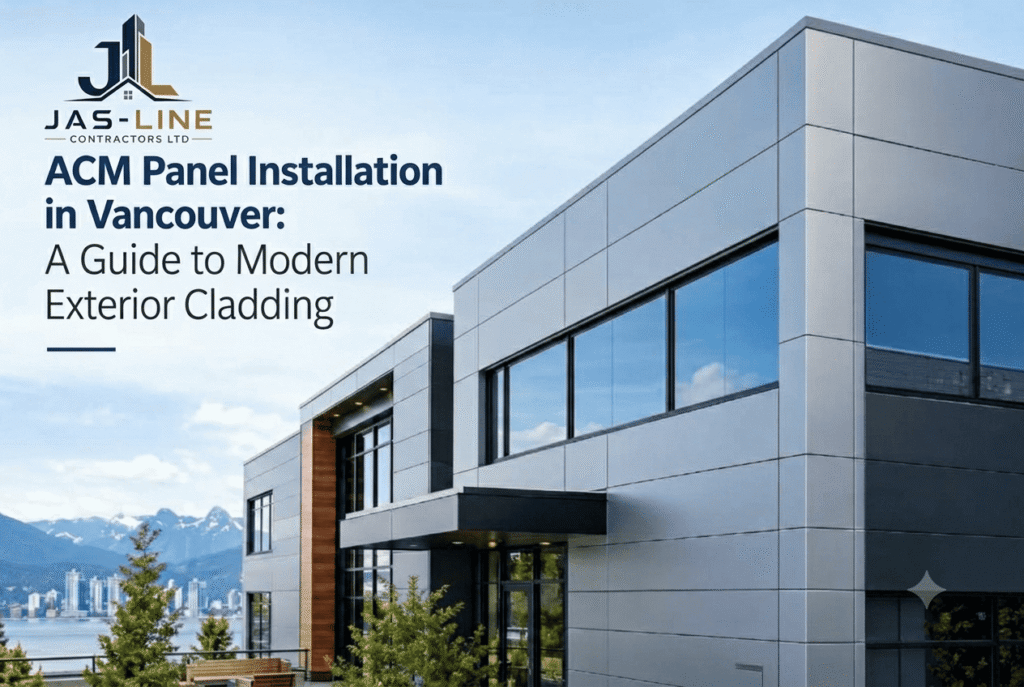
The exterior of a building has to do more than create a good first impression. The cladding needs to work with the wall assembly, accommodate openings and transitions, and be selected with the building’s design and performance requirements in mind.
For many commercial, residential, and renovation projects, ACM panel installation Vancouver is one option worth considering. ACM, or Aluminium Composite Material, provides a clean panelled appearance and can be used for exterior walls, commercial façades, architectural features, and renovation projects.
At Jas-Line Contractors Ltd., ACM panel installation is offered for residential and commercial projects, including exterior wall cladding, commercial building façades, architectural feature panels, new construction cladding, and exterior renovation upgrades.
What is ACM Panel Installation in Vancouver?
ACM panels are composite panels made with aluminium skins bonded to a core material. They are available in different colours, finishes, sizes, and configurations, allowing designers and contractors to create a range of exterior layouts.
ACM panels Vancouver projects can include commercial façades, retail and storefront exteriors, office buildings, multi-unit properties, entrances, architectural feature walls, soffits, and exterior renovation work.
The panels themselves are only one part of the system. Before installation, the project should be considered as a complete exterior wall assembly. Substrate condition, attachment methods, flashing, openings, moisture management, fire-performance requirements, and the manufacturer’s installation requirements can all affect how the system is designed and installed.
That is why choosing an ACM panel should not be based on appearance alone.
Why Consider ACM Cladding for a Vancouver Project?
ACM can be a practical option when a project calls for a contemporary exterior finish and carefully planned panel layout. The right application depends on the building, the selected product, and the complete wall assembly.
A Clean, Modern Appearance
One of the most noticeable characteristics of ACM is its clean, panelled appearance. Large façade areas can be divided into consistent horizontal or vertical layouts, while different colours and finishes can be used to create architectural features.
ACM can also be combined with materials such as glass, concrete, metal, or other cladding products when the design calls for a mixed-material façade.
Lightweight Panel Construction
Aluminium composite panels are relatively lightweight compared with some heavier exterior cladding materials. This can make them suitable for certain new construction and renovation applications.
That does not mean the structural requirements can be overlooked. The substrate and attachment system still need to be appropriate for the specific project.
Flexible Design Options
Depending on the selected manufacturer and product, ACM systems may offer a range of:
- Colours
- Finishes
- Textures
- Panel dimensions
- Joint patterns
- Profiles
- Layout options
This flexibility allows the façade design to be coordinated around windows, doors, corners, entrances, and other architectural elements.
Practical for Different Building Types
Aluminum composite panels Vancouver projects can include both residential and commercial applications.
They may be considered for:
- Office buildings
- Retail spaces
- Multi-unit residential buildings
- Mixed-use properties
- Commercial renovations
- New construction
- Building entrances
- Feature walls
- Canopies and architectural accents
The appropriate product and installation method should always be determined according to the project requirements.
ACM Panel Installation Vancouver: What Does the Process Involve?
A good ACM installation is not simply a matter of fastening panels to a wall. The panels have to be coordinated with the substrate, wall assembly, openings, flashing, transitions, and other exterior components.
Here is a practical overview of the process.
1. Review the Building and Project Requirements
The first step is to understand the existing building or the new construction design.
For an existing property, the wall should be reviewed for conditions that could affect the installation, such as damaged substrate, uneven surfaces, moisture-related concerns, or areas that require preparation.
For new construction, the ACM installation should follow the project’s architectural details, specifications, and building-envelope requirements.
2. Prepare the Substrate
The surface supporting the ACM system needs to be suitable for the specified installation method.
Depending on the project, preparation may involve repairs, framing, levelling, or other work before the panels are installed. A properly prepared substrate helps maintain consistent panel alignment and joint spacing.
Where steel framing is part of the project, Jas-Line also provides Steel Stud Framing as a related service.
3. Consider Moisture and Water Management
Exterior cladding should be considered as part of the building envelope rather than as an isolated finish.
The BC Building Code addresses protection from precipitation and describes exterior wall assemblies that use multiple planes of protection. Rainscreen assemblies, for example, can incorporate cladding, drainage space, and other components that work together to manage water. The exact wall assembly depends on the building and project requirements.
For Vancouver projects, the applicable Vancouver Building By-law should also be reviewed because the City of Vancouver has its own building regulations under the Vancouver Charter.
Related work such as insulation and vapour control may also form part of the overall wall assembly. Jas-Line provides Insulation & Vapour Barrier services for residential and commercial projects.
4. Plan the Panel Layout
Panel layout has a major effect on the finished appearance.
Before installation, the layout should account for:
- Panel dimensions
- Joint locations
- Corners
- Windows and doors
- Building openings
- Changes in direction
- Transitions between materials
- Soffits and fascia
- Architectural features
Taking time to plan these details can help avoid awkward joints and unnecessary visual interruptions.
5. Fabricate and Install the Panels
Depending on the selected ACM system, panels may be cut, routed, folded, formed, or fabricated to suit the required configuration.
The installation method should follow the product specifications and project details. Fasteners, clips, rails, joints, and other components need to be compatible with the specified system.
Accuracy matters here. Small inconsistencies in panel alignment can become much more noticeable across a large façade.
6. Detail Corners, Openings, and Transitions
Windows, doors, corners, parapets, soffits, and material transitions deserve particular attention.
These areas are where several building components meet, so the detailing needs to be coordinated with the overall wall assembly rather than added as an afterthought.
Why Proper ACM Panel Installation Matters
The quality of an exterior cladding project is not determined by the panels alone. The installation needs to work with the rest of the wall assembly.
When selecting ACM panel installers Vancouver property owners, builders, and contractors should look for an approach that considers:
- Accurate measurements
- Proper substrate preparation
- Panel alignment
- Appropriate attachment methods
- Consistent joint spacing
- Corner and opening details
- Flashing coordination
- Moisture management
- Compatibility with adjacent materials
- Manufacturer requirements
- Applicable building requirements
For projects that also involve interior construction, Jas-Line’s Drywall, Taping & Finishing services can support the interior side of the work.
ACM Cladding vs. Other Exterior Cladding Options
There is no single exterior cladding material that is right for every building.
When comparing exterior cladding Vancouver options, property owners and project teams may need to consider appearance, durability, maintenance, weight, installation requirements, fire performance, moisture management, budget, and the overall design of the wall assembly.
ACM may be worth considering when the project calls for:
- A contemporary architectural appearance
- Large flat panel areas
- Defined horizontal or vertical lines
- Different colour and finish options
- A relatively lightweight panel system
- Commercial or architectural façade applications
- A combination of ACM with other exterior materials
At the same time, ACM should not be selected simply because it looks modern. Product specifications and the complete wall assembly need to be evaluated for the particular building.
ACM Panels for Commercial Buildings
Commercial projects often place additional emphasis on façade appearance, entrances, material transitions, and architectural detailing.
Commercial cladding Vancouver projects may include office buildings, retail spaces, mixed-use properties, commercial renovations, and other buildings where the exterior plays a visible role.
ACM can be considered for:
- Storefront feature areas
- Commercial entrances
- Office façades
- Feature walls
- Building signage areas
- Columns
- Canopies
- Architectural accents
For projects involving multiple trades, ACM installation may also be coordinated with related construction work such as steel stud framing, insulation, vapour barrier installation, firestopping, drywall, and painting.
📞 Contact Us today to discuss your construction project and request a project-specific estimate.
Residential vs. Commercial ACM Applications
ACM is not limited to large commercial buildings. It can also be considered for selected residential and multi-unit applications.
Residential Projects
For residential work, ACM may be used for selected exterior areas, architectural features, entrances, additions, or renovation projects.
The scale may be smaller than a commercial façade, but the same basic principles apply: the substrate, attachment system, openings, moisture management, and product requirements still need to be considered.
Commercial Projects
Commercial applications can involve much larger façade areas and more complex coordination around storefronts, windows, doors, signage, entrances, and other architectural features.
Commercial projects may also require coordination between several trades and project documents, making early planning particularly useful.
Common ACM Installation Problems to Avoid
Many exterior cladding problems are related to detailing and coordination rather than the panel material itself.
Poor Substrate Preparation
Installing panels over an unsuitable or uneven substrate can make alignment difficult and may affect the finished appearance.
Inconsistent Joint Layout
Random or poorly planned joints can make a façade look unbalanced. Joint locations should be considered before fabrication and installation.
Ignoring Openings and Transitions
Windows, doors, corners, parapets, and transitions require detailed planning. Treating them as secondary details can create problems later.
Choosing a Product Based Only on Appearance
Two ACM products may look similar while having different specifications or performance characteristics. Product selection should therefore consider the requirements of the actual project.
Treating Cladding as a Stand-Alone Finish
The exterior panel is only one component of the wall. The cladding needs to work with the underlying wall assembly and moisture-management strategy.
Not Reviewing Applicable Requirements
Building requirements can vary depending on the location, building type, construction, and scope of work. Vancouver projects should be reviewed against the applicable Vancouver Building By-law and project requirements rather than relying on general assumptions.
How to Choose an ACM Panel Installation Contractor
When comparing ACM panel installation contractors, do not focus only on the appearance of completed panels.
Ask how the contractor approaches:
- Substrate preparation
- Panel layout
- Openings and transitions
- Attachment methods
- Moisture-management details
- Manufacturer installation requirements
- Coordination with other trades
- Site conditions
- Project scheduling
- Clean-up after installation
It is also useful to discuss the scope before work begins. A clear understanding of the existing wall, selected ACM system, drawings, specifications, and related trades can reduce misunderstandings during construction.
Jas-Line Contractors currently lists ACM panel installation as a service for residential and commercial projects, including exterior wall cladding, commercial building façades, architectural feature panels, new construction cladding, and exterior renovation upgrades.
📞 Contact Us today to discuss your ACM cladding project in Vancouver.
Maintenance Considerations for ACM Cladding
ACM can require relatively little routine maintenance, but exterior façades should still be inspected periodically.
Property owners can watch for:
- Damaged panels
- Loose or damaged components
- Deteriorated sealants
- Damaged flashing
- Water-related concerns
- Changes around windows and doors
- Dirt or surface buildup
Cleaning methods should follow the recommendations for the specific product and finish. Harsh cleaning methods can damage some coated surfaces, so the manufacturer’s guidance should be followed.
Regular inspections can also help identify visible problems before they become more difficult to address.
How Much Does ACM Panel Installation Cost in Vancouver?
There is no reliable single price for ACM panel installation Vancouver projects because the scope can vary significantly from one building to another.
Factors that may affect project cost include:
- Total façade area
- Panel type and finish
- Panel thickness and core
- Fabrication requirements
- Building height
- Existing wall condition
- Substrate preparation
- Site access
- Number and size of openings
- Corners and architectural details
- Wall assembly requirements
- Labour and installation complexity
For that reason, a project-specific assessment is more useful than relying on a generic cost-per-square-foot figure.
Is ACM Cladding Right for your Vancouver Project?
ACM may be a good option when you want a clean, contemporary exterior and the project can accommodate the requirements of the selected panel system.
The material can be used across a variety of residential and commercial applications, but the decision should be based on more than appearance. The building type, wall assembly, product specifications, moisture management, fire-performance requirements, attachment method, and architectural design all need to be considered.
For projects that involve additional construction work, Jas-Line can also provide related services including steel stud framing, drywall finishing, painting, insulation and vapour barrier work, firestopping, and construction clean-up.
Frequently Asked Questions About ACM Panel Installation in Vancouver
1. What is ACM cladding?
ACM cladding uses Aluminium Composite Material panels as an exterior finish. The panels typically consist of aluminium skins bonded to a core and can be manufactured in different sizes, finishes, and configurations.
2. Is ACM suitable for Vancouver buildings?
ACM can be used on Vancouver projects, but suitability depends on the specific product, building type, wall assembly, design, and applicable requirements. The complete exterior wall system should be evaluated rather than considering the panel by itself.
3. Where are ACM panels commonly used?
ACM panels can be used for commercial façades, retail spaces, office buildings, multi-unit properties, entrances, architectural feature areas, new construction, and exterior renovation projects.
4. Are ACM panels low maintenance?
ACM can be relatively low maintenance, but regular inspection and appropriate cleaning are still recommended. Maintenance requirements depend on the selected product and finish.
5. Can ACM panels be used on residential buildings?
They can be used for certain residential and multi-unit applications. The appropriate system depends on the building design, product specifications, wall assembly, and applicable requirements.
6. How long does ACM panel installation take?
Installation time varies according to the size and complexity of the project, panel fabrication, site access, substrate preparation, weather, openings, and coordination with other construction work. A realistic schedule should be established after the project scope has been reviewed.
Final Thoughts
ACM panel installation Vancouver projects require more than attractive panels and clean lines. The installation needs to be planned around the building, the wall assembly, the selected product, openings, transitions, moisture management, and applicable requirements.
For property owners, builders, and developers considering ACM panels Vancouver, taking the time to understand these details can help create a more coordinated exterior cladding project.
Jas-Line Contractors Ltd. provides ACM panel installation for residential and commercial projects, along with related construction services that can support different stages of a project.