
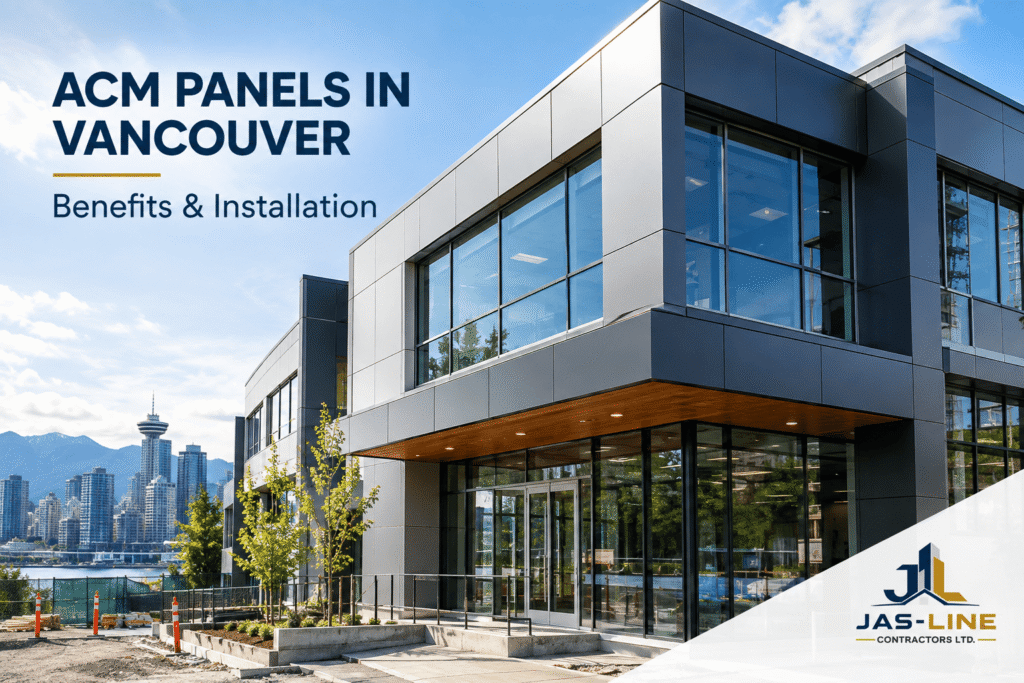
Choosing exterior cladding is about more than selecting a material that looks good. The cladding needs to work with the building envelope, suit the application, and be installed with attention to the substrate, joints, moisture management and attachment system.
ACM panels in Vancouver are used on a range of commercial, multi-family, retail and architectural projects where a clean, contemporary exterior is desired. ACM stands for Aluminum Composite Material. These panels typically consist of two aluminium sheets bonded to a central core, creating a relatively lightweight and rigid panel that can be fabricated into different shapes and layouts.
There are many ACM products available, with differences in thickness, finish, colour and core construction. Those differences matter when selecting a system for a particular building.
For property owners, builders and project managers, the key is to look beyond the visible panel. The supporting wall, air and water-control layers, insulation, flashing, attachment method and fire-performance requirements all need to be considered as part of the overall assembly.
📞 Call us or Contact Us today.
What are ACM Panels?
ACM panels, also known as aluminium composite panels or aluminum composite material panels, are manufactured from thin aluminium skins bonded to a central core.
The construction provides a relatively lightweight panel with a consistent, flat exterior surface. Depending on the product and its intended application, ACM can be fabricated for exterior façades, storefronts, feature walls, entrances, soffits, fascia, canopies and other architectural details.
Common applications include:
- Exterior building façades
- Commercial storefronts
- Building entrances
- Feature walls
- Soffits and fascia
- Columns and architectural features
- Canopies
- Signage and branding areas
- Selected residential and multi-family applications
The appropriate panel should be selected according to the building design, application and project requirements rather than appearance alone.
Why Consider ACM Panels in Vancouver?
There is no single cladding product that works for every building. ACM cladding in Vancouver can be a practical option when the project calls for a modern appearance, design flexibility and a relatively lightweight exterior panel.
Clean, Contemporary Appearance
One of the main reasons ACM is selected is its appearance. Properly fabricated and installed panels can create broad, flat surfaces with consistent joints and defined architectural lines.
Different colours and finishes can also be combined to create contrast around entrances, windows and other features.
For a property owner, this makes ACM useful when the exterior appearance needs to complement the overall architectural design without relying on several different cladding materials.
Relatively Lightweight Construction
Compared with some heavier solid materials, ACM can provide a rigid exterior surface with relatively low panel weight.
This can be useful when planning a new façade or working on an existing building. However, a lightweight panel does not mean that every existing wall is automatically suitable for an ACM system.
The substrate, supporting structure and attachment method still need to be assessed before installation.
Choice of Colours and Finishes
Aluminum composite panels in Vancouver are available in a range of colours and finishes, depending on the manufacturer and product line.
Options may include:
- Solid colours
- Metallic finishes
- Matte finishes
- Gloss finishes
- Brushed appearances
- Wood-look finishes
- Custom colours
This gives designers and property owners flexibility when coordinating ACM with other exterior materials and architectural elements.
Routine Maintenance
ACM can be relatively straightforward to maintain when the appropriate product is installed and maintained according to the manufacturer’s instructions.
Regular visual inspection and suitable cleaning can help keep the exterior looking presentable. Maintenance requirements, however, can vary depending on the panel coating, location and exposure.
The manufacturer’s maintenance instructions should always take precedence over a general maintenance schedule.
Flexible Fabrication
ACM sheets can be fabricated and routed to suit different façade layouts and architectural details.
This can make them useful around:
- Windows
- Doors
- Corners
- Columns
- Entrances
- Parapets
- Feature areas
Because large flat panels can make small alignment errors more noticeable, accurate measurements and careful detailing are important during fabrication and installation.
Common Applications for ACM Panels
ACM wall panels can be used in a variety of commercial, residential and architectural settings.
Commercial Buildings
Commercial ACM panels Vancouver projects may include office buildings, retail properties, restaurants, mixed-use buildings and other commercial structures.
ACM can be used across an exterior façade or as an architectural accent around selected areas of a building.
For commercial work, the cladding system should be coordinated with the architectural drawings and the rest of the building envelope.
Retail Storefronts and Entrances
ACM is often considered for storefronts and entrances where a clean transition between exterior materials is desired.
Possible applications include:
- Storefront surrounds
- Entrance features
- Signage areas
- Canopies
- Columns
- Feature walls
The panel colour, finish and joint layout can also be coordinated with the property’s overall design.
Residential and Multi-Family Buildings
ACM can be incorporated into selected residential and multi-family projects as full or partial exterior cladding, architectural accents or feature areas.
For these applications, the panel should be treated as one part of the exterior wall assembly. It should not be viewed simply as a decorative layer placed over an otherwise unrelated wall system.
Renovations and Re-Cladding
ACM may also be considered when an existing building is being renovated or re-clad.
Before work begins, the existing substrate should be assessed for condition, compatibility and potential moisture-related problems.
Installing new exterior panels without addressing an underlying wall problem can simply conceal the issue rather than solve it.
📞 Call us or Contact Us today to discuss your project requirements.
ACM Cladding and the Building Envelope
One of the most common points to understand about ACM cladding installation is that the visible panel is only one component of the exterior wall.
Depending on the project, an exterior wall assembly may include:
- Structural framing
- Sheathing
- Air and water-control layers
- Insulation
- Subframing
- Drainage space
- Flashing
- Fasteners and clips
- ACM panels
This is why ACM panel installation in Vancouver should be considered as part of the complete wall assembly rather than as an isolated finishing step.
The ACM panel itself does not replace insulation, an air barrier, vapour-control layer or other building-envelope components.
Where a project also involves insulation or air/vapour-control work, insulation and vapour barrier services should be coordinated with the exterior cladding work so the different parts of the wall assembly work together.
ACM Panel Installation Considerations
Good ACM installation starts well before the first panel is fixed to the wall. Material selection, substrate preparation, panel layout and detailing all affect the finished result.
1. Assess the Existing Substrate
The supporting surface should be checked before installation.
The substrate needs to be suitable for the proposed ACM system and attachment method. Damaged, uneven or deteriorated areas should be identified before the panels are installed.
This is particularly noticeable with large flat panels, where irregularities in the supporting surface can become visible through the finished layout.
2. Select the Appropriate Panel and Core
Not all ACM products are the same.
Panel thickness, coating, core composition and fire-performance characteristics can differ between products. The selected material therefore needs to match the building, application and project requirements.
Fire performance should receive particular attention. Different ACM core types can have different fire characteristics. Product documentation and the applicable requirements for the specific building and wall assembly should be reviewed before material selection and installation.
Where a project has specific code or fire-performance requirements, those requirements should be verified with the appropriate design professional, authority having jurisdiction or other qualified party rather than assumed.
3. Plan the Panel Layout
The layout of the panels has a direct effect on the finished appearance.
Before fabrication and installation, the project team should consider:
- Panel dimensions
- Joint locations
- Window and door openings
- Corners
- Material transitions
- Building geometry
- Movement considerations
- Attachment locations
A well-planned layout can reduce unnecessary cuts and help maintain consistent joints across the façade.
4. Coordinate Moisture Management
Exterior cladding forms part of a larger wall system. Depending on the specified design, the assembly may incorporate drainage or ventilation behind the cladding to manage water that reaches the exterior wall.
Flashing, penetrations, joints and transitions require appropriate detailing as well.
This becomes particularly relevant when ACM is being installed during an existing building renovation, where the condition of the underlying wall may not be known until the existing cladding is opened.
5. Use a Suitable Attachment System
There are different ways to fabricate and attach ACM panels.
The appropriate approach depends on the specified product, panel design, substrate and project requirements.
Fasteners, clips, subframing and related components should be compatible with the system and installed according to the manufacturer’s instructions and project specifications.
6. Pay Attention to Joints and Transitions
Panel joints are highly visible on an ACM façade.
Misaligned joints can affect the overall appearance, even when the individual panels themselves are correctly fabricated.
Corners, window openings, parapets and transitions between ACM and other materials should therefore be measured and detailed carefully.
The goal is not simply to create straight lines. The joint and attachment details also need to work with the movement and performance requirements of the wall system.
Common Problems to Avoid With ACM Installation
Many ACM problems can be reduced through planning before fabrication begins.
Installing Over an Unsuitable Substrate
A new panel system cannot compensate for a damaged or unsuitable supporting surface. The substrate should be assessed before installation rather than after problems become visible.
Choosing a Panel Based Only on Appearance
Colour and finish are only part of the selection process.
The panel’s core, thickness, coating, fire characteristics and compatibility with the proposed assembly also need to be considered.
Poor Panel Layout
Even a high-quality ACM product can look inconsistent if joint locations, openings and panel dimensions were not properly coordinated.
Ignoring the Wall Behind the Panels
ACM should not be used to conceal unresolved moisture or building-envelope problems.
The condition of the underlying assembly needs to be understood before a new cladding system is installed.
Using Incompatible Components
Fasteners, clips, subframing and other attachment components need to be suitable for the specified system and substrate.
Using components without confirming compatibility can create problems with both installation and long-term performance.
Residential vs. Commercial ACM Projects
The basic principles of ACM installation apply to both residential and commercial projects, but the project requirements can be quite different.
A smaller residential project may use ACM as an architectural accent, entrance feature or limited area of exterior cladding. A larger commercial building may involve extensive panel layouts, multiple transitions and more detailed coordination with architectural and building-envelope drawings.
Commercial projects can also involve more extensive coordination between trades.
Where an exterior renovation affects interior walls, drywall installation and finishing services may be required as part of the broader work. If the interior is being finished after the drywall work, painting services can be coordinated with the construction schedule.
Where interior partitions or related framing work are involved, steel stud framing services may also form part of the project.
The specific scope depends on the building and the renovation plan.
How to Choose an ACM Panel Contractor in Vancouver
Finding an ACM panel contractor Vancouver property owners can rely on starts with asking practical questions about the proposed installation.
Before work begins, consider asking:
Does the contractor understand the complete wall assembly?
ACM is not an independent replacement for every component behind the cladding. The proposed installation should account for the substrate and relevant building-envelope layers.
What panel system is being proposed?
Ask for the manufacturer’s product information and confirm that the selected panel is appropriate for the intended application.
How will the panels be attached?
The attachment method should be suitable for the specified product, substrate and project design.
How will joints and transitions be handled?
Ask how the layout will be coordinated around windows, doors, corners, parapets and transitions to other materials.
What happens if an existing wall has problems?
For renovation work, it is worth discussing how damaged substrate or previously unidentified moisture-related issues will be handled if they are discovered during the work.
A contractor who can clearly explain the installation approach gives the property owner a better understanding of what is actually being proposed.
📞 Call us or Contact Us today.
When Are ACM Panels a Good Option?
ACM panels in Vancouver may be worth considering when a project calls for:
- A contemporary exterior appearance
- Consistent flat panel surfaces
- A choice of colours and finishes
- Relatively lightweight cladding
- Flexible façade layouts
- Architectural accent areas
- Commercial or selected multi-family applications
They are not automatically the best choice for every building. The right decision depends on the project design, substrate, wall assembly, exposure, budget and applicable requirements.
Frequently Asked Questions
1. Are ACM panels suitable for buildings in Vancouver?
ACM can be suitable for a range of commercial, multi-family and architectural applications. The appropriate system depends on the building design, substrate, selected product and project requirements.
2. What are ACM panels made of?
ACM generally consists of two aluminium sheets bonded to a central core. The exact construction and core type vary between products.
3. Are ACM panels fire resistant?
Fire performance varies between ACM products and core types. The specific product documentation and requirements for the proposed wall assembly should be reviewed before the material is selected.
4. Where are ACM panels commonly used?
ACM can be used for commercial façades, storefronts, entrances, feature walls, architectural accents, soffits, canopies and selected residential or multi-family applications.
5. Do ACM panels replace insulation or a vapour barrier?
No. ACM is an exterior cladding material and does not automatically replace insulation, an air barrier, vapour-control layer or other components of the wall assembly.
6. What should be checked before ACM installation?
The substrate, panel specification, core, attachment system, panel layout, joints, flashing and relationship to the overall building-envelope assembly should be reviewed before installation.
Final Thoughts
ACM panels in Vancouver can be a practical cladding option for projects that call for a clean architectural finish, design flexibility and relatively lightweight exterior panels.
The visible panel, however, is only one part of the installation. The substrate, attachment system, panel layout, joints, moisture management and fire-performance requirements all need to be considered as part of the complete wall assembly.
For ACM panel installation in Vancouver, careful planning before fabrication can help avoid many of the problems that become difficult or expensive to correct later.
Whether ACM is being considered for a commercial façade, storefront, multi-family building, renovation or architectural feature, the material should be selected and installed according to the needs of the specific project.
At Jas-Line Contractors Ltd., related construction work such as framing, insulation, vapour-barrier, drywall and painting can also be considered as part of the broader project scope where applicable.
📞 Call us or Contact Us today.