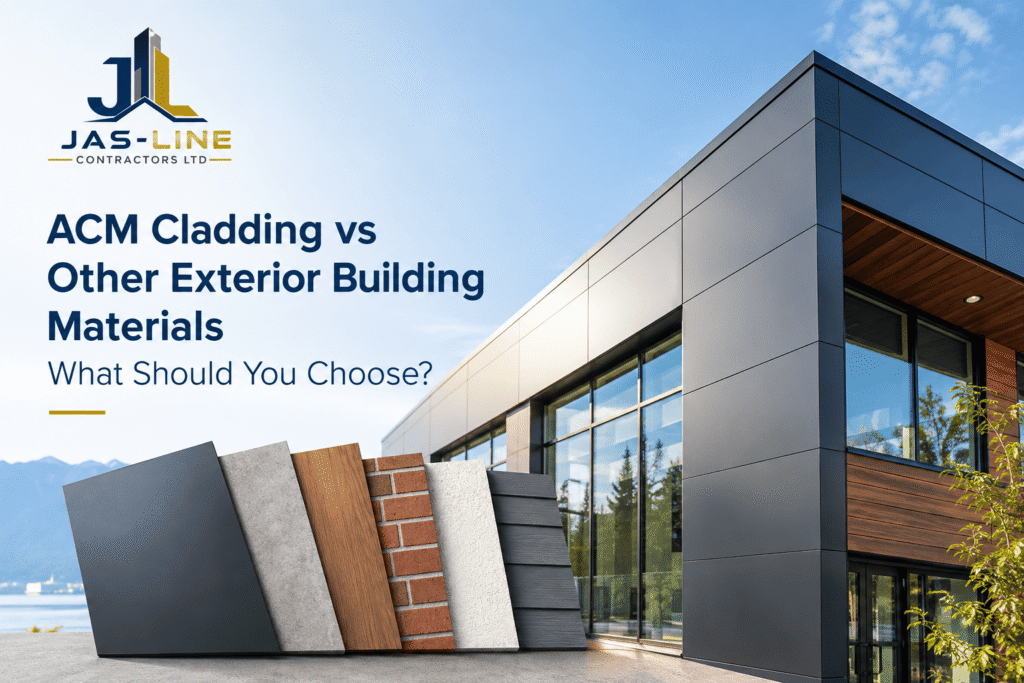
Choosing an exterior cladding system is not simply a matter of picking a colour or finish. The material has to suit the building’s design, wall assembly, installation requirements, maintenance expectations, and project budget.
For property owners, builders, and developers considering ACM cladding Vancouver, the decision often comes down to how aluminum composite panels compare with alternatives such as brick, stucco, fibre cement, vinyl siding, and other metal cladding systems.
ACM can provide a clean, contemporary appearance and flexible design options, but that does not automatically make it the right choice for every project. The surrounding wall assembly and the way the cladding is detailed and installed matter just as much as the visible finish.
This guide looks at the practical differences between ACM and other common exterior materials and outlines what to consider when planning a project in Vancouver, British Columbia.
What is ACM Cladding?
ACM stands for Aluminum Composite Material. ACM panels are generally manufactured with aluminum skins bonded to a core material. They are used as exterior wall finishes on a range of commercial, institutional, multi-unit, and architectural projects.
One of the main characteristics of ACM exterior cladding Vancouver projects can benefit from is its clean panel appearance. Depending on the product and design, panels can be fabricated in different colours, finishes, sizes, and configurations.
ACM is a finish material rather than a complete wall assembly. The panels work as part of a larger exterior wall system that may include sheathing, membranes, insulation, air barriers, flashings, fasteners, and a drainage or ventilation space.
That distinction is worth keeping in mind when comparing ACM with other exterior materials.
📞 Call us or Contact Us today.
Why ACM Cladding Requires Careful Consideration in Vancouver
The suitability of an exterior cladding system depends on the building and its complete wall assembly, not simply on the cladding material itself.
The BC Building Code includes requirements dealing with exterior walls and protection against precipitation ingress. Depending on the building type and applicable code provisions, the wall assembly may need appropriate layers of protection, drainage, ventilation, and detailing.
For this reason, an exterior cladding Vancouver project should be evaluated as a building-envelope system rather than as a finish-only decision.
The specific requirements can also vary depending on factors such as:
- Building type and occupancy
- Height and size of the building
- Existing or new construction
- Wall assembly
- Cladding material and product
- Fire-performance requirements
- Moisture management
- Applicable code provisions
Where a project involves a significant alteration or recladding, the existing wall construction also needs to be understood before new materials are added.
ACM Cladding vs Fibre Cement
Fibre cement and ACM serve different design purposes, although both can be used as exterior cladding.
Fibre cement is available in different profiles, textures, and finishes. It is commonly used where the design calls for a more traditional siding appearance or a material that can resemble wood.
ACM generally has a more contemporary appearance, with smooth surfaces and defined panel joints.
ACM Cladding
Potential advantages include:
- Clean, modern appearance
- Lightweight panel construction
- A variety of colours and finishes
- Flexible panel layouts
- Suitable for many commercial and architectural applications
Some considerations include:
- Accurate fabrication is required
- Panel joints and transitions need careful detailing
- Installation quality can affect both appearance and performance
- The complete wall assembly must be considered
Fibre Cement
Fibre cement may be suitable where the project calls for:
- Traditional or residential-style siding
- Textured or profiled finishes
- A different visual character from smooth ACM panels
The choice should be based on the building’s design, wall assembly, installation requirements, budget, and expected maintenance.
ACM Cladding vs Stucco
Stucco is another established exterior finish used on residential and commercial buildings.
It can provide a relatively continuous finished appearance and can be used with different architectural styles. ACM takes a different approach, using individual panels and visible joints to create a more structured façade.
For a contemporary commercial building, ACM may fit the design better. A project designed around a stucco finish may call for a different wall system altogether.
Rather than choosing one material based only on appearance, it is worth considering how the exterior finish works with the underlying wall construction, openings, transitions, drainage, and other building-envelope components.
ACM Cladding vs Brick
Brick offers a very different appearance and construction approach from ACM.
Brick masonry is heavier and requires appropriate structural support and detailing. ACM panels are comparatively lightweight and can be used to create large, clean façade surfaces.
Aluminum composite panels Vancouver projects may use can also be combined with brick rather than replacing it entirely. A building may use ACM around entrances, upper façade sections, storefront areas, or other architectural features while retaining brick elsewhere.
When comparing the two, consider:
- Structural requirements
- Desired architectural style
- Installation method
- Available wall depth
- Maintenance requirements
- Overall project budget
- Compatibility with the existing building
ACM Cladding vs Vinyl Siding
Vinyl siding is commonly associated with residential construction and is available in a range of colours and profiles.
ACM has a distinctly different appearance and is more commonly considered when a project calls for a contemporary architectural façade.
For a commercial renovation or modern building, commercial cladding Vancouver projects may incorporate ACM as part of a broader façade design.
That does not mean ACM is automatically preferable. Vinyl may make more sense for certain residential projects where its appearance, installation method, and budget are appropriate.
The building’s purpose and design should drive the decision.
📞 Call us or Contact Us today.
ACM Cladding vs Other Metal Cladding
Not all metal cladding systems are the same.
Traditional metal siding may use steel or aluminum panels formed into specific profiles. ACM uses composite panels with aluminum skins and a core.
Both systems can be used in contemporary construction, but they can have different installation methods, appearances, panel dimensions, detailing requirements, and product specifications.
For this reason, an ACM panel installation Vancouver project should be planned around the specific ACM product being used rather than treating ACM as interchangeable with every other metal siding system.
What Should You Consider Before Choosing Exterior Cladding?
1. Building Design
Start with the architectural requirements.
If the design calls for clean panel lines, smooth surfaces, and a contemporary façade, ACM may be a suitable option.
If the project calls for a traditional masonry, stucco, or siding appearance, another material may be a better fit.
The exterior should also work with windows, doors, rooflines, parapets, corners, and other building features.
2. Wall Assembly and Moisture Management
The visible cladding is only one part of the exterior wall.
The wall assembly may include:
- Structural framing
- Sheathing
- Insulation
- Air barrier
- Vapour control layer where required
- Flashings
- Drainage or ventilation space
- Exterior cladding
BC Building Code provisions address the need to manage precipitation and moisture in exterior wall assemblies. The exact requirements depend on the project and applicable code provisions.
This is why cladding selection and building-envelope detailing should be considered together.
3. Installation Requirements
ACM panels require accurate measurements, fabrication, layout, fastening, and detailing.
An experienced ACM panel installer Vancouver property owners hire should pay close attention to:
- Panel alignment
- Joint layout
- Fasteners and attachment
- Corners and transitions
- Window and door openings
- Flashings
- Penetrations
- Drainage
- Interface with other wall components
The manufacturer’s installation requirements should also be followed for the selected product.
4. Maintenance
Every exterior material has maintenance requirements.
For ACM, maintenance can include routine cleaning and inspection of the façade and its associated components. Other materials may have different requirements depending on their finish, exposure, installation, and age.
When comparing materials, consider not only the initial appearance but also how the exterior will be maintained over time.
5. Budget
The material price is only one part of the overall cost.
A realistic comparison may need to account for:
- Material
- Labour
- Substrate preparation
- Framing or support requirements
- Flashing
- Weatherproofing
- Installation
- Access equipment
- Maintenance
- Future repairs
The actual cost will depend on the building and project scope, so it should be assessed on a project-specific basis rather than estimated from the cladding material alone.
When is ACM Cladding a Suitable Option?
ACM cladding Vancouver projects may be a good fit when the building design calls for:
- A contemporary exterior
- Clean and defined panel lines
- A range of colour and finish options
- Lightweight panel construction
- Flexible façade layouts
- A commercial or architectural appearance
It can be considered for offices, retail buildings, commercial properties, multi-unit developments, tenant improvements, and renovation projects.
However, suitability should always be assessed against the complete wall assembly, product specifications, code requirements, and project conditions.
Residential vs Commercial ACM Cladding
ACM is particularly common in commercial and architectural applications, but the suitability of the material is ultimately project-specific.
Residential Projects
For residential buildings, the decision may depend heavily on the desired appearance, building form, existing wall assembly, budget, and maintenance expectations.
Other materials such as fibre cement, vinyl, brick, or stucco may be considered depending on the design.
Commercial Projects
Commercial buildings often have larger façade areas and may use several exterior materials together.
Commercial building cladding Vancouver projects can incorporate ACM around entrances, storefronts, feature walls, parapets, or larger façade sections. ACM can also be combined with glass, brick, concrete, fibre cement, and other finishes.
The final design should be coordinated with the building envelope, structure, fire requirements, and other trades.
📞 Call us or Contact Us today.
Common ACM Cladding Problems to Avoid
Many exterior-cladding problems are not caused by the visible panel itself. They can result from poor detailing, incompatible materials, incorrect installation, or problems elsewhere in the wall assembly.
Common issues to watch for include:
Poor Panel Alignment
Inconsistent joints or panel alignment can be noticeable across a large façade. Accurate layout and installation help maintain a consistent appearance.
Inadequate Detailing Around Openings
Windows, doors, penetrations, and transitions require careful detailing. These areas need to work with the wall’s water-management strategy.
Ignoring the Existing Wall Assembly
When recladding an existing building, adding a new exterior material without understanding the existing wall can create problems.
The condition and configuration of the existing assembly should be reviewed before work begins.
Choosing a Material Based Only on Appearance
A cladding may look appropriate in a design concept but still be unsuitable for the particular wall assembly or project requirements.
Appearance, performance, installation, maintenance, and code requirements should all be considered together.
What to Look for in an ACM Cladding Contractor
Choosing an ACM cladding contractor Vancouver property owners can rely on involves more than comparing material prices.
Before starting a project, ask the contractor about:
- Their proposed cladding system
- Product specifications
- Installation method
- How joints and transitions will be handled
- How windows and doors will be integrated
- How the cladding will connect with the existing wall assembly
- Required substrate preparation
- Coordination with other trades
- Manufacturer installation requirements
- Applicable building-code requirements
For larger or technically complex projects, the contractor may also need to coordinate with the project’s architect, engineer, building-envelope consultant, or other professionals.
A reputable exterior cladding contractor Vancouver property owners work with should be able to explain the proposed approach clearly rather than simply recommending a material.
Why ACM Installation Quality Matters
Good materials still need good installation.
A properly planned ACM panel installation Vancouver project involves more than attaching panels to a wall. The installer needs to understand the panel system, substrate, attachment method, joints, openings, flashings, and interfaces with other components.
The National Research Council of Canada identifies exterior walls as part of the building enclosure and publishes construction specifications and technical resources covering exterior wall systems and related components.
For projects where code compliance, fire performance, or building-envelope performance is a concern, the applicable requirements should be reviewed for the specific building and product rather than assumed.
How to Choose Between ACM and Other Exterior Materials
There is no universal answer to whether ACM is better than brick, stucco, fibre cement, vinyl, or another cladding system.
A practical comparison should look at:
- Building type — residential, commercial, institutional, or mixed-use
- Architectural design — modern, traditional, industrial, or mixed-material
- Wall assembly — existing or new construction
- Moisture management — drainage, flashing, and wall protection
- Fire and code requirements — based on the specific building and applicable code
- Installation requirements — fabrication, attachment, access, and detailing
- Maintenance — cleaning, inspection, and future repairs
- Budget — complete installed project cost rather than material price alone
- Long-term requirements — how the façade needs to perform and be maintained
Taking this approach helps keep the decision focused on the actual building rather than on marketing claims about one material.
Frequently Asked Questions
1. Is ACM cladding suitable for buildings in Vancouver?
ACM can be used for exterior wall applications, but suitability depends on the specific product, wall assembly, building type, installation method, and applicable code requirements. A project should be reviewed as a complete exterior wall system rather than based on the ACM panel alone.
2. Is ACM cladding only used for commercial buildings?
No. ACM can be considered for different types of projects, although it is particularly associated with contemporary commercial and architectural façades. The appropriate exterior material depends on the design and technical requirements of the building.
3. How does ACM compare with brick or stucco?
ACM provides a different appearance and construction approach. Brick is a masonry system, while stucco is a finish system with its own assembly requirements. ACM uses manufactured panels and typically creates more defined panel joints. The right choice depends on the building design, wall assembly, installation requirements, and budget.
4. Does ACM cladding require maintenance?
Like any exterior finish, ACM should be inspected and maintained. Cleaning requirements and other maintenance needs depend on the product, finish, exposure, and installation.
5. What does ACM panel installation involve?
Installation can involve substrate preparation, panel measurement and fabrication, layout, attachment, joint detailing, flashing, and coordination around windows, doors, corners, and other penetrations. The exact process depends on the selected ACM system and manufacturer requirements.
6. How do I choose an ACM cladding contractor in Vancouver?
Look for a contractor who can clearly explain the proposed panel system, installation method, substrate requirements, detailing around openings, and coordination with the building envelope. It is also reasonable to ask how the contractor will follow the manufacturer’s installation requirements and address applicable building-code considerations.
📞 Call us or Contact Us today.
Final Thoughts
The right exterior material depends on the building, not simply on which product looks best on a sample board.
ACM cladding Vancouver projects may offer a practical option for buildings that require a contemporary façade, flexible panel layouts, and a range of finishes. At the same time, brick, stucco, fibre cement, vinyl, and other metal cladding systems may be more appropriate for different designs and wall assemblies.
The most useful comparison is therefore based on the complete system: the building design, existing or proposed wall assembly, moisture management, installation requirements, maintenance, budget, and applicable code provisions.
For a Vancouver project, Jas-Line Contractors Ltd. can discuss the cladding requirements with you and help determine what installation approach fits the scope of the work. For project-specific code or building-envelope requirements, the appropriate design professional or authority having jurisdiction should be consulted.
Website: Jas-Line Contractors Ltd.