
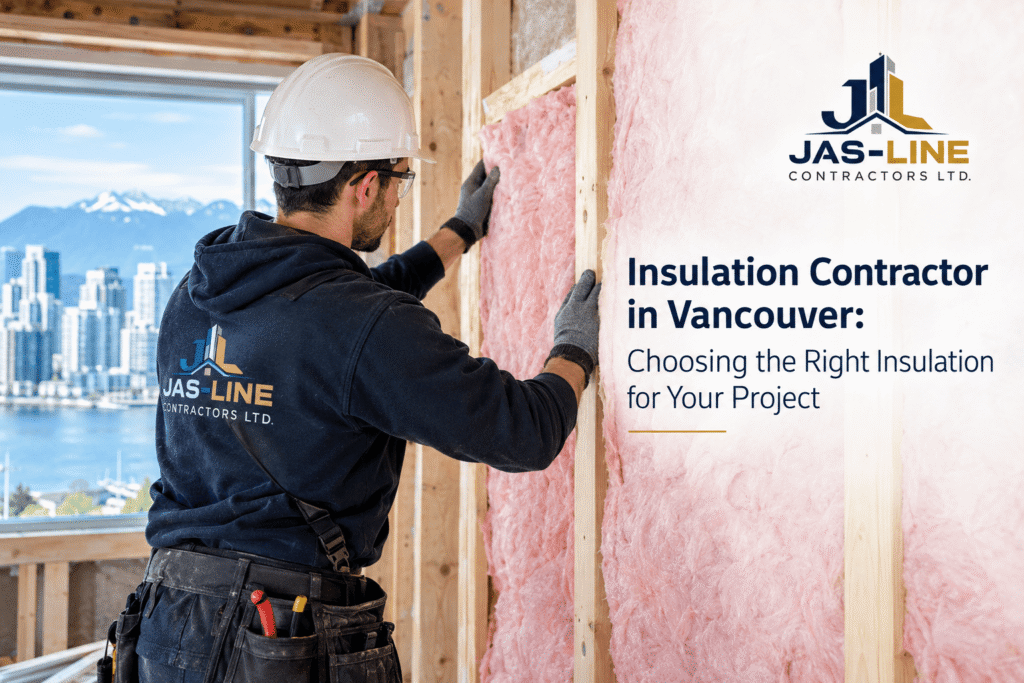
Choosing insulation for a renovation or new construction project is not simply a matter of selecting the product with the highest R-value. The right approach depends on where the insulation will be installed, how the wall or ceiling is built, the available space, moisture control requirements, and how the insulation will work with the rest of the building assembly.
For homeowners, builders, and property managers looking for an insulation contractor Vancouver, understanding these factors can make it easier to compare insulation options and plan the work properly.
At Jas-Line Contractors Ltd., insulation and vapour barrier work can be coordinated with related construction services such as steel stud framing, drywall, taping and finishing, and painting. This can be particularly useful when insulation is part of a larger renovation or new construction project.
What does an Insulation Contractor in Vancouver Do?
An insulation contractor is responsible for installing insulation in areas such as walls, ceilings, attics, basements, and other parts of a building where thermal or acoustic performance is required.
Depending on the project, the work may include:
- Reviewing the existing wall, ceiling, or floor assembly
- Identifying damaged, missing, or inadequate insulation
- Selecting an insulation type suited to the application
- Preparing cavities or surfaces before installation
- Installing insulation with appropriate coverage and fit
- Coordinating insulation with air and vapour control measures
- Working around electrical, plumbing, and mechanical services
- Preparing the assembly for drywall and interior finishes
The details matter. A suitable insulation product can still perform poorly if it is badly fitted, compressed, left with significant gaps, or installed without considering the rest of the assembly.
For projects governed by the BC Building Code, Section 9.25 addresses heat transfer, air leakage, and condensation control, including thermal insulation, air barriers, and vapour barriers. However, projects within the City of Vancouver are subject to the City’s own building bylaw, so project-specific requirements should always be verified with the applicable authority.
Why Insulation Matters for Vancouver and BC Projects
Insulation helps slow heat transfer between areas of different temperatures. In practical terms, it can form an important part of the building envelope in exterior walls, ceilings, roofs, floors, and other assemblies.
The value of good insulation planning goes beyond simply adding more material.
Better Interior Comfort
Poorly insulated or inconsistently insulated areas can contribute to temperature differences within a building. Properly designed and installed insulation can help create a more consistent interior environment.
Control of Heat Transfer
Insulation reduces the movement of heat through the building assembly. Its actual performance depends on several factors, including the insulation material, thickness, installation quality, thermal bridging, and the construction of the complete assembly.
Moisture and Condensation Considerations
Insulation is only one part of moisture control.
Air barriers and vapour barriers have different functions, and their placement within an assembly matters. In applicable BC Building Code assemblies, these components are addressed together as part of heat, air, and moisture control.
Acoustic Performance
Some insulation products can also be used for sound control. This can be useful for interior partitions, multi-unit buildings, offices, bedrooms, home theatres, and other areas where reducing sound transmission is part of the project.
Jas-Line’s current insulation service includes batt and soundproof insulation for applications such as wall insulation, ceiling and attic insulation, basement insulation, interior wall sound insulation, and office or residential sound control.
Common Insulation Options
There is no single insulation product that works best for every building assembly. Material selection should follow the requirements of the particular application.
Fibreglass Batt Insulation
Fibreglass batts are commonly installed between wall studs, floor joists, and ceiling framing.
They can be a practical option where framing cavities are regular and accessible. The batt needs to fit the cavity properly. Large gaps, excessive compression, or poorly cut sections can reduce the effectiveness of the installation.
For this reason, wall insulation Vancouver projects should consider both the insulation product and the condition of the framing cavity.
Blown-In Insulation
Blown-in insulation can be suitable for certain attic and retrofit applications.
One advantage is that loose-fill material can sometimes be installed in spaces where conventional batt insulation would be difficult to fit. The suitability of this method depends on the existing assembly and the specific project.
Spray Foam Insulation
Spray foam is applied directly to the building assembly and expands during installation. Different spray foam products have different characteristics, so the product needs to be selected according to the intended application and applicable requirements.
A higher R-value per unit of thickness does not automatically make spray foam the right choice for every project. Product specifications, installation conditions, fire considerations, moisture control, and the complete assembly all need to be considered.
BC Building Code Appeal Board decisions also illustrate that the suitability and code treatment of particular insulation products can depend on the product and application.
Rigid Foam Board Insulation
Rigid insulation boards can be used in selected wall, foundation, basement, and other assemblies.
Their performance depends not only on the board itself but also on how it is incorporated into the complete assembly. Joints, penetrations, transitions, and surrounding materials all need to be considered.
How to Choose the Right Insulation for your Project
When comparing insulation contractors Vancouver, it is worth looking beyond the material name or advertised R-value. A good insulation plan starts with the building assembly and the conditions on site.
1. Where Will the Insulation Be Installed?
An attic is not the same as an exterior wall. A basement wall is different again, and an interior partition may have acoustic requirements rather than the same thermal requirements as an exterior assembly.
The location affects the material, installation method, thickness, detailing, and other components that may be required.
2. What is already behind the Wall or Ceiling?
This question becomes especially important during renovations.
Before adding new insulation, the contractor may need to consider:
- Existing framing
- Previous insulation
- Moisture or water damage
- Electrical wiring
- Plumbing
- Ventilation
- Air leakage
- Available cavity depth
- Existing air or vapour control layers
Simply filling an accessible cavity with new insulation without understanding the existing assembly can create problems or leave the underlying issue unresolved.
3. What R-Value is Appropriate?
R-value measures resistance to heat flow, but it should not be the only factor used to compare insulation systems.
The required thermal performance depends on the building assembly and the applicable requirements. Installation quality also matters. Gaps, compression, thermal bridging, and other components of the assembly can affect overall performance.
The better question is often not, “Which insulation has the highest R-value?”
It is:
“Which insulation system is appropriate for this particular assembly?”
4. How Will Moisture and Air Movement be Controlled?
Insulation, air barriers, and vapour barriers perform different jobs.
A vapour barrier is intended to control vapour diffusion. An air barrier is intended to control air movement through the assembly. Insulation primarily helps control heat transfer.
These components need to work together as part of the building envelope. For projects subject to the BC Building Code, Section 9.25 addresses these areas directly.
For Vancouver projects, the applicable City of Vancouver requirements should also be confirmed where the City has jurisdiction.
5. How Will Insulation Coordinate With the Other Trades?
Insulation is often installed between framing and the interior finish, which means its installation needs to be coordinated with other work.
A renovation sequence may look broadly like:
Framing → insulation → required air/vapour-control work → drywall → taping and finishing → painting
For example, Jas-Line provides steel stud framing services, drywall installation, taping and finishing, and painting services, making these relevant internal links when those services form part of the same project.
Insulation for New Construction vs. Renovation
The insulation requirements and practical considerations can be quite different between a new build and an existing property.
New Construction
With new construction, insulation can be considered while the wall and ceiling assemblies are being planned.
This gives the project team an opportunity to coordinate:
- Framing dimensions
- Insulation depth
- Electrical and plumbing penetrations
- Air sealing
- Vapour control
- Drywall installation
- Interior finishes
Planning these components together can reduce the need for modifications later.
Renovation Projects
Renovations can be less predictable because the contractor is working with an existing building.
Once a wall or ceiling is opened, the actual conditions may differ from what was expected. There may be older insulation, unexpected framing, previous repairs, moisture damage, wiring, plumbing, or other obstructions.
That is why an insulation contractor Vancouver property owners hire should assess the actual conditions before recommending an installation method.
📞 Call us or Contact Us today to discuss your insulation, vapour barrier, renovation, or new construction requirements.
Insulation and Vapour Barriers: What Property Owners Should Know
Insulation and vapour barriers are not the same thing.
Insulation helps reduce heat transfer.
A vapour barrier controls the movement of water vapour through the assembly.
An air barrier controls air movement through the assembly.
The three can be closely related within a wall or ceiling system, but they serve different purposes. Their location and continuity need to be considered as part of the complete assembly.
Jas-Line Contractors Ltd. currently provides insulation and vapour barrier services, including wall and ceiling vapour barrier installation, moisture-control work, batt insulation, soundproof insulation, attic and basement insulation, and renovation insulation upgrades.
For a project that includes both insulation and vapour-control work, linking directly to the Jas-Line Insulation & Vapour Barrier service page is a natural internal-link opportunity.
Insulation and Drywall: Why the two need to be Coordinated
Once insulation and the required building-envelope work are completed, walls and ceilings may be ready for drywall.
Before the assembly is closed, it is worth checking that insulation is properly installed and that accessible gaps or penetrations have been addressed.
This can help avoid unnecessary work after drywall has been installed.
Jas-Line’s drywall service includes drywall installation for new construction, renovations, basement development, ceilings, commercial build-outs, replacements, and repairs.
A natural internal link here is:
drywall installation, taping and finishing
After the drywall stage, the project may move on to taping, sanding, surface preparation, and painting.
Common Insulation Problems to Watch For
Insulation problems are not always caused by choosing the wrong product. Installation and existing building conditions can be just as significant.
Common issues can include:
Gaps Around the Insulation
Small gaps can leave portions of a cavity less insulated than intended. Batt insulation should generally be fitted to the available space rather than installed with obvious voids.
Compressed Insulation
Compressing insulation can change its installed thickness and affect its intended thermal performance.
Ignoring Existing Moisture Problems
Adding insulation over a moisture problem does not solve the underlying cause. If water intrusion or excessive moisture is present, that issue should be investigated before the assembly is closed.
Treating R-Value as the Only Measure
A higher R-value does not automatically mean a product is the right choice. The complete assembly and installation conditions need to be considered.
Closing the Wall Too Early
Once drywall is installed, much of the wall assembly is no longer visible. It is better to review accessible insulation and related work before closing the wall.
Installing Without Understanding the Existing Assembly
This is particularly relevant in older renovations. Existing materials may affect what can be added, removed, or changed.
Residential vs. Commercial Insulation
The basic principles of insulation apply to both residential and commercial construction, but the project requirements can be very different.
Residential Insulation
Residential projects may involve:
- Exterior wall insulation
- Attic and ceiling insulation
- Basement insulation
- Interior sound insulation
- Renovation insulation upgrades
- Vapour barrier installation
For residential insulation Vancouver projects, the existing construction can be particularly relevant when renovating older walls, ceilings, or basements.
Commercial Insulation
Commercial projects may involve larger areas, multiple wall and ceiling assemblies, tenant improvements, offices, retail spaces, multi-unit buildings, or other specialized spaces.
Coordination becomes especially important where insulation is being installed alongside steel stud framing, drywall, firestopping, mechanical services, electrical work, and other trades.
For commercial insulation Vancouver projects, the insulation should be selected and installed according to the project specifications and applicable requirements rather than using a one-size-fits-all approach.
When Should you Consider an Insulation Upgrade?
An insulation assessment may make sense when:
- You are renovating an exterior wall or ceiling.
- Existing insulation is damaged, missing, or deteriorated.
- You are finishing a previously unfinished basement or attic area.
- You are opening walls for renovation work.
- Certain areas of the building have noticeable temperature differences.
- You are planning an interior sound-control upgrade.
- You are reviewing the building envelope as part of a larger renovation.
These signs do not automatically mean insulation is the cause of a building problem. Temperature differences, for example, can also be related to windows, air leakage, heating distribution, or other construction details.
A site assessment can help determine what work is actually required.
How to Choose an Insulation Contractor in Vancouver
If you are looking for a Vancouver insulation contractor, consider asking the following questions before starting the work.
Does the contractor assess the existing assembly?
For renovations, this is particularly useful. The contractor should understand what is already present before recommending a new insulation system.
Can they explain the insulation options?
You should be able to understand why a particular material is being recommended and where it will be installed.
Do they consider vapour and air control?
Insulation should not be treated as an isolated product when the wall or ceiling assembly also requires air and vapour control.
How will the insulation coordinate with other trades?
Ask how the work will fit with framing, electrical, plumbing, drywall, finishing, and painting.
What preparation is required?
Moisture, damaged materials, obstructions, or existing building conditions may need to be addressed before insulation can be installed.
Can the contractor handle related work?
If the project also requires framing, drywall, finishing, painting, or other construction services, coordinating the work can make project communication simpler.
Jas-Line Contractors currently lists residential and commercial services including steel stud framing, drywall/taping/finishing, painting, firestopping, insulation and vapour barrier work, and ACM panel installation and construction clean-up.
Why Consider Jas-Line Contractors Ltd.?
Insulation is often one stage within a larger renovation or construction project. The work may begin with framing, continue through insulation and vapour-control work, and then move into drywall, finishing, and painting.
Jas-Line Contractors Ltd. provides insulation and vapour barrier services for residential and commercial projects, including wall insulation, ceiling and attic insulation, basement insulation, sound insulation, vapour barrier installation, and renovation insulation upgrades.
Where appropriate, the work can also be coordinated with:
- Steel stud framing
- Drywall, taping and finishing
- Painting
- Firestopping
- Construction clean-up
These should be linked to the corresponding Jas-Line service pages rather than linking the same keyword repeatedly throughout the article.
📞 Call us or Contact Us today to discuss your residential or commercial insulation project.
Frequently Asked Questions
1. What type of insulation is best for a Vancouver home?
There is no single insulation type that is best for every home. The appropriate choice depends on the location, existing assembly, available space, moisture conditions, and applicable project requirements.
2. How do I choose an insulation contractor in Vancouver?
Look for a contractor who assesses the existing assembly, explains the available insulation options, understands air and vapour control, and can coordinate the work with other trades where required.
3. Is spray foam better than fibreglass insulation?
Not automatically. Spray foam and fibreglass have different characteristics and applications. The better option depends on the particular wall, ceiling, floor, or other assembly.
4. What is the difference between insulation and a vapour barrier?
Insulation primarily helps control heat transfer. A vapour barrier is intended to control vapour diffusion. They are different components and should be considered as part of the overall building assembly.
5. Can insulation be installed during a renovation?
Yes. Renovations can provide a good opportunity to inspect or upgrade insulation, particularly when walls or ceilings are already being opened. Existing conditions should be assessed before the new insulation is installed.
6. Does insulation also help with soundproofing?
Some insulation products and assemblies can help reduce sound transmission. The result depends on the complete wall or ceiling assembly, not just the insulation material itself.
Final Thoughts
Choosing insulation should start with the building assembly, not simply with the insulation product.
Fibreglass batts, blown-in insulation, spray foam, and rigid insulation can all have appropriate applications. The right choice depends on where the material will be installed, the existing construction, available space, moisture conditions, required performance, and how the insulation will interact with the rest of the assembly.
For homeowners, builders, and property managers searching for an insulation contractor Vancouver, a practical starting point is to have the existing conditions assessed and then select an insulation system that fits the project.
At Jas-Line Contractors Ltd., insulation and vapour barrier work can also be coordinated with framing, drywall, finishing, painting, and other construction services where those stages are part of the same project.