Choosing the right framing material is an important decision for any construction or renovation project. Construction framing forms the framework for walls, ceilings, partitions, and other interior elements, so the material should match the project’s design, requirements, budget, and applicable building codes.
Two widely used options are steel stud framing and wood framing. Both can provide reliable results when properly designed and installed, but each has different characteristics. Here’s a look at the key differences between steel vs wood framing. CONTACT US
What Is Steel Stud Framing?
Steel stud framing uses steel studs and tracks to create wall, partition, and ceiling frameworks. Cold-formed steel framing is manufactured to consistent dimensions, supporting accurate layouts and straight wall construction.
Steel framing is used in residential and commercial applications, including interior partitions, renovations, multi-unit buildings, and offices. Stud size, thickness, spacing, and configuration depend on the project requirements.
For projects requiring accurate interior wall framing, steel studs can provide consistent dimensions and predictable installation.
What Is Wood Framing?
Wood framing uses timber studs and other wood components to create building and interior frameworks. It has been used extensively in construction, particularly in residential framing and conventional home construction.
Wood is relatively easy to cut and modify on site, making wood frame construction practical for many conventional construction applications. Proper design, installation, and moisture protection are important for long-term performance.
Steel Stud Framing vs. Wood Framing: Key Differences
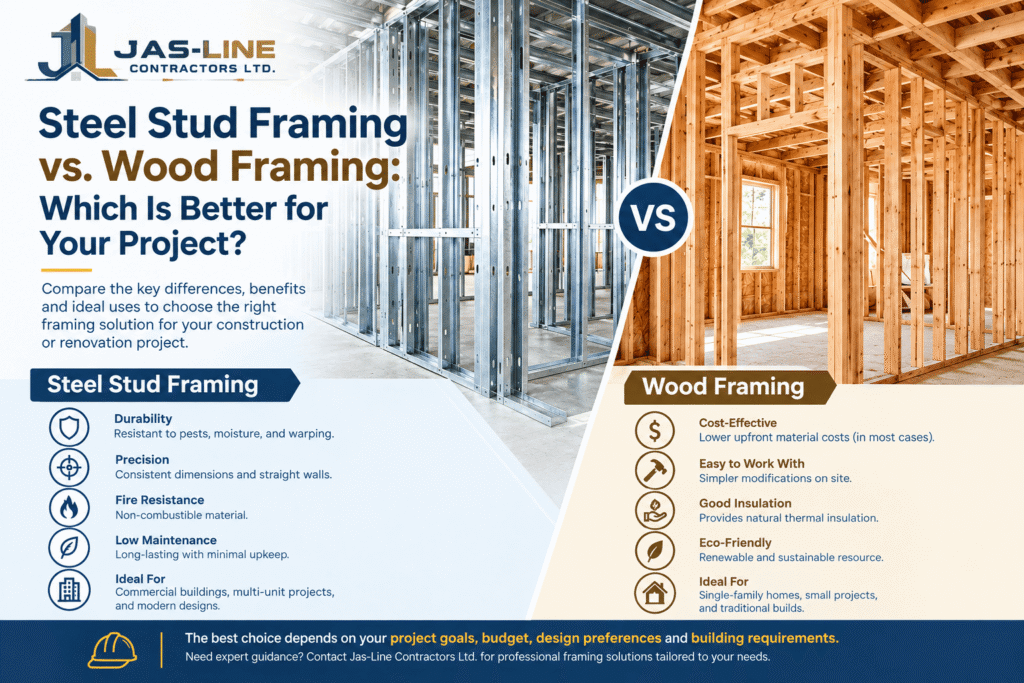
1. Durability and Pest Resistance
Steel is not susceptible to termite attack and does not rot like untreated wood. This can make steel stud framing attractive where pest resistance and dimensional stability are important.
Wood can also provide long-lasting performance when properly protected from moisture, insects, and deterioration.
2. Precision and Consistency
Steel studs are manufactured to consistent dimensions, helping provide predictable construction framing and accurate wall layouts. This can be useful where precise interior finishes are required.
Wood framing can also achieve excellent accuracy with skilled installation, although natural variations can affect straightness and dimensions.
3. Fire Performance
Steel is a non-combustible material, which can be an important consideration in certain construction applications. However, the fire rating of a wall depends on the complete tested or approved assembly, including framing, gypsum board, insulation, and other components.
Wood is combustible, but properly designed wood-framed assemblies can also meet applicable fire-resistance requirements.
4. Cost
There is no universal answer to which framing material is cheaper. The cost of steel framing and wood framing varies with material prices, labour, engineering, project size, installation methods, transportation, and local market conditions.
A project-specific estimate provides a more accurate comparison than general price assumptions.
5. Applications and Flexibility
Both materials can be used for a range of construction designs.
Steel stud framing is often suitable for interior partitions, commercial framing, multi-unit projects, offices, renovations, and applications where consistent framing is important.
Wood framing is widely used in residential construction and can be convenient where on-site cutting and modifications are required.
Which Framing Option Is Better?
The best option depends on your project requirements.
Steel stud framing may be worth considering when you need:
- Consistent framing dimensions
- Pest-resistant framing
- Non-combustible framing material
- Precise interior wall layouts
- Residential or commercial framing
- Durable framing solutions
Wood framing may be suitable when you need:
- A conventional residential framing method
- Easy on-site modifications
- Widely available materials
- Practical residential framing solutions
The final decision should consider the building design, structural requirements, local codes, project conditions, and overall budget.
Why Professional Installation Matters
The quality of a framing system depends not only on the material but also on proper framing installation. Accurate measurements, correct spacing, secure connections, alignment, and coordination with electrical, plumbing, insulation, and drywall work are all important.
For steel framing, it is also important to distinguish between structural and nonstructural applications because they have different design requirements.
Working with experienced professional framing contractors can help ensure that the selected framing system is installed correctly and according to project requirements.
Choose the Right Framing Solution
Steel stud framing and wood framing can both be effective when properly selected, designed, and installed. Instead of choosing one material based on a single advantage, consider the complete requirements of your project.
Jas-Line Contractors Ltd. provides professional framing solutions for residential and commercial construction and renovation projects, with a focus on precision, quality workmanship, and reliable project execution. Contact US
Planning a construction or renovation project? Contact Jas-Line Contractors Ltd. to discuss your framing requirements and determine a suitable solution for your project. CONTACT US