
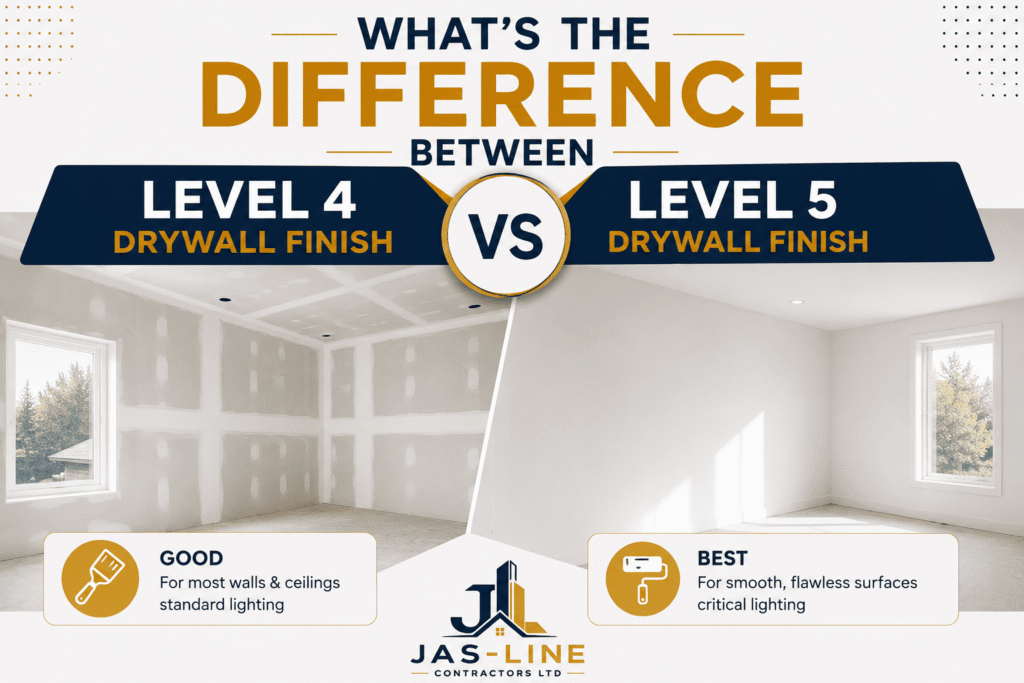
If you’re planning a renovation and your contractor mentioned “level 4” or “level 5” finish and moved on like you already knew what that meant — you’re not alone. This is one of those industry terms that gets thrown around a lot, but rarely gets explained in plain language. So let’s actually break it down. CONTACT US
Level 4 – the standard most homes get, and for good reason
A level 4 finish is what the vast majority of homes are finished to, and honestly, it’s the right call for most rooms. It involves taping every joint, then applying multiple coats of joint compound over seams, corners, and fastener heads, sanding it smooth along the way. What you end up with is a clean, flat surface — good enough that under normal room lighting, you won’t notice any seams or imperfections once it’s painted.
This level works well for bedrooms, living rooms, hallways, offices — basically any standard space getting flat or eggshell paint. If that’s your project, level 4 is genuinely correct, not a compromise.
Level 5 – the upgrade for spaces where light doesn’t forgive mistakes
Level 5 does everything level 4 does, then adds one more step: a thin skim coat of joint compound applied across the entire wall or ceiling surface, not just the seams. That extra layer creates one continuous, uniform surface from edge to edge, with zero texture difference between where the joints were and everywhere else.
Why go through the extra work? Because even a well-done level 4 finish has a subtle difference in how paint sits over joint compound versus how it sits on the raw drywall paper in between. Under normal lighting, you’d genuinely never notice. But under strong natural light hitting the wall at a low angle, or architectural lighting like wall washers and spotlights, that difference can show up as a faint banding or shadowing along the seams.
So when do you actually need level 5?
A few situations where it’s worth the upgrade:
- Rooms with large windows or floor-to-ceiling glass
- Dark paint colors, which make any surface imperfection far more visible
- Gloss, semi-gloss, or satin paint sheens — these reflect light and expose flaws that flat paint would hide
- Modern, high-end interiors with directional or architectural lighting
- Ceilings or walls that catch strong grazing sunlight
If none of that applies to your space, level 4 will look just as good in practice, for meaningfully less cost.
What’s the actual cost and time difference?
Level 5 typically runs noticeably more than level 4 for the same square footage — the extra cost comes from the added material, labor, and the extra drying time the skim coat requires before final sanding. It also adds time to your renovation timeline, since that skim coat needs to fully dry before the final sanding and priming can happen.
It’s a real cost difference, not a marginal one — which is exactly why it’s worth knowing whether your space actually needs it before you pay for it.
Our honest take
Don’t upgrade to level 5 just because it sounds like “the better option.” For most homes and most rooms, level 4 is genuinely the right finish — it’s what the vast majority of interiors are built to, and it looks flawless under normal living conditions. Level 5 earns its cost specifically in high-light, high-sheen, or high-end architectural situations where a level 4 finish would show its seams.
If you’re not sure which one your space actually calls for, that’s exactly the kind of question worth asking your contractor before the quote — not after the walls are already up. CONTACT US
FAQs
Q1. Is level 5 drywall finish worth the extra cost?
It depends on the space. For rooms with large windows, dark paint, glossy sheens, or architectural lighting, level 5 is usually worth it. For standard rooms with flat or eggshell paint, level 4 is typically sufficient.
Q2. What is a skim coat in drywall finishing?
A skim coat is a thin layer of joint compound applied across the entire wall or ceiling surface (not just the seams) as part of a level 5 finish, creating one uniform texture from edge to edge.
Q3. Can level 4 drywall be used with glossy paint?
It’s not recommended. Level 4 isn’t ideal for high-sheen finishes like semi-gloss or gloss paint, since these can highlight even minor surface imperfections. Level 5 is the better fit for glossy paint applications.
Q4. How much more does level 5 drywall finish cost than level 4?
Level 5 generally costs more per square foot than level 4, mainly due to the additional skim coat material, labor, and extended drying time it requires.
Q5. What drywall finish level is standard for most homes?
Level 4 is the standard finish for most residential spaces, including bedrooms, living rooms, and hallways with flat or eggshell paint.